Saturday, July 1, 2017

Flash Forward at Oceanside Museum of Art

By Patricia Frischer

I have been instrumental in arranging a NCAN meeting at Oceanside Museum of Arts (OMA) taking a look at the challenges we have to meet and opportunities available in 2018 and beyond in the art in San Diego. My special area of expertise is obviously visual arts and I do spend a considerable amount of time thinking about this subject. 

There is a group of shows at Oceanside Museum of Art called Healing Journeys: Veterans and Artist Unit which I think is a perfect example of the future now. The Arts and Culture community is going to be called upon more and more to advocate for social issues. To do that effectively they need to be able to collaborate and aid intersections within the community. They also need to provide a meeting place for those wishing to come out from in back of their computers. That audience is increasingly wanting to do more than look, they want to have the making experience. OMA demonstrates all these qualities and that is why they are considered effective leaders and why there relevancy is assured. 

Learn more at: 


Flash Forward: North County Arts Network’s roundup of future cultural events, trends, predictions, visions and directions.
Wednesday, July 12, 2017 from 9 am to 11 am
Oceanside Museum of Art
704 Pier View Way, Oceanside CA 92054


Flash Forward: NCAN’s roundup of future cultural events at Oceanside Museum of Art on Wednesday July 12, 2017 from 9 am to 11 am. Industry leaders in Visual Arts, Theater, Music, Dance and Spoken Word will make overview presentations in their particularly area of expertise. The emphasis will be on sector directions in 2018 and beyond. Come and learn what the future holds and become part of the intersections in North County between all the arts. There will be updates on the Arts and Economic Summit and news about the revised website plus a chance to network with colleagues before and after the presentations.

Hosted and Moderated by Maria Mingalone, Executive Director, 
Oceanside Museum of Art
Visual Arts: Kerri Fox, Vice President, Marketing,  New Children’s Museum, President of the SD County Museum Council
Theater: Chris Williams, Associate Artistic Director, North Coast Rep
Dance: Emily Miller, Director, Performing Arts Workshop
Music: Naimeh Tahna, President, Encinitas Friends of the Arts
Spoken Word: Danny Salzhandler, 101 Artist Colony/Full Moon Poets

Meaning In BronzeMay 27–October 8, 2017

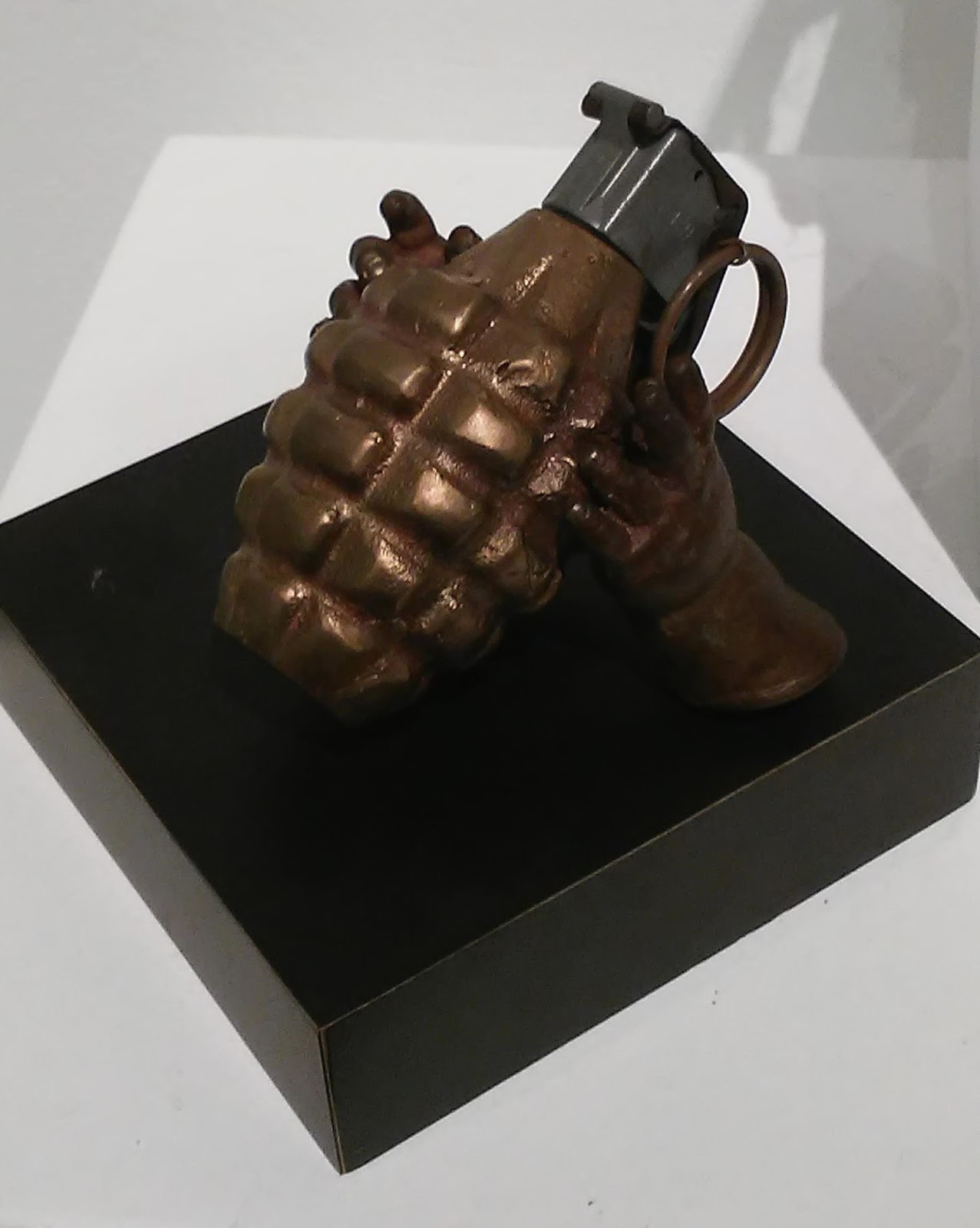
Veterans works with the VetArts team (started by Stephen Dilley and aided by Mark Jesinoski with instructors Kevin Larson and Scott Hickey) to re-create their faces. Casting in bronze is laborious process which calls for strength and dexterity and concentration. This makes it particularly suited to veterans. I found their statements very moving, but just seeing their faces was compelling.  


Work by the instructors was included and they are veterans themselves and used the medium to communicate complex issues.  
Kevin Larson

Scott Hickey

Scott Hickey

Ted Meyer: Scarred For Life: May 27–September 17, 2017

Ted Meyer has connected with survivors of wars, accidents, and mental and physical health issues by layering paint on top of the skin, rubbing it to record the actual contours of the scars left by these incidents. Not only has Meyer embellished the resulting marks on the paper, but photo of the survivors with their stories in their own words makes a strong visual statement.  


Coming up is one more exhibition in this series: A Time To HealJuly 29–October 8, 2017. A small group of veterans wrote letters to themselves, reflecting on hardship and healing during workshops facilitated by artist Trinh Mai at the museum. These letters have been incorporated into the “war wounds” that participants created using various materials.

But there is another exhibition by Michelle Montjoy that also demonstrates community involvement in  making art. River from March 25–July 9, 2017 is a small show which documents the participation of people who, using large table top looms or finger crocheting, contributed to a visual conversation by knitting or crocheting, braiding or knotting a form using old t-shirts.  
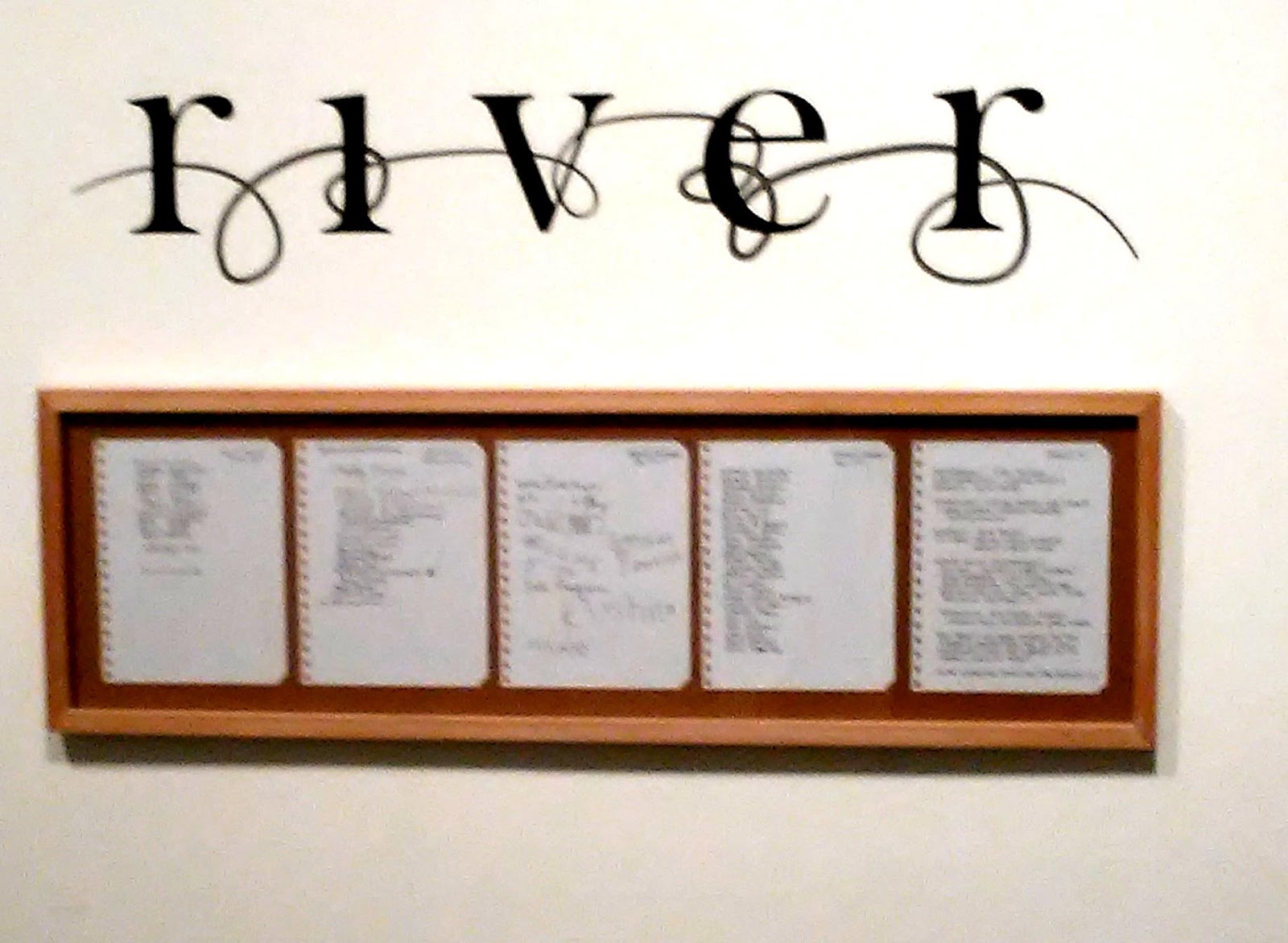


More of Michelle Montjoy's work can be seen at the entrance and when ascending and descending the main staircase. Ms. Montjoy is currently in the New Contemporaries exhibition. You have until Aug 4 to visit and vote for your own choice of New Contemporaries emerging artists nominated for the San Diego Art Prize. There is a second reception for this show on July 8 from 6 to 9 pm at basileIE + CMCuratorial in Barrio Logan. San Diego Visual Arts Network who produced the San Diego Art Prize is putting up a cash prize for the public choice award but you have to be present at the venue to vote with your smart device. at www.sdvan.net/app. Here are links to 
The New Contemporaries 2017 Catalog is now available for download.
2017 New Contemporaries SD Art Prize Picked RAW Peeled by Patricia Frischer


Sunday, June 25, 2017

Sculpture in the SD Botanic Gardens in Encinitas

By Patricia Frischer

From June 2017 to April 2018 you can see a new selection of local artist's sculptures at the SD Botanic Garden in Encinitas.  Naomi Nussbaum hand selection each of the 29 artist to exhibit in this space and carefully situates each to their best advantage. The images below do not show the exquisite experience of finding these works near the fruit gardens and bamboo groves, ponds and waterfalls.

There are colorful mosaics, detailed figurative work, abstract conceptual art and amazing  works made from glass, metal, marble, steel, and even  from a rusted bathtub. Ms. Nussbaum changes the work every year and all the works are for sale. She does a stunning job which is a benefit to the artists (many of which have multiple works) and to the SD Botanic Garden who benefits not only from the special juxtapositions, which enliven their wonderful specimens, but also from a percentage of the sales.  Lucky are the visitors and collectors and staff who have the sheer joy of strolling through this living gallery.


MARSHA RAFTER

MARCELA LUNA ROSSEL

JULIA REASOR WITH HER ART WORK

ILYA IDELCHIK AND YURIY AKOPOV

LAURENN BARKER


JON KOEHLER

ROBERT MICHAEL JONES

ELON EBANKS

DAVID CAMPBELL

JOHN DUPREE

BOB PETRELLO (Photo credit: Zulma  Miranda)

JAMES HUBBEL

SYD HARRIS

STEVE SHIGLEY

BELIZE IRISTAY

PETER MITTEN

CHERRIE LA PORTE

MARK RAFTER

DEANNE SABECK

Monday, June 19, 2017

2017 New Contemporaries SD Art Prize

by Patricia Frischer

2017 New Contemporaries SD Art Prize Nominated Artists at basileIE + CMCuratorial continuing until Sat. August 5.

You can vote again for your favorite artist who will receive an extra cash prize until Friday Aug 4.  There is a closing reception  Sat Aug 5 and announcement of Art Prize emerging artists recipients from 4 to 6 pm


basileIE + CMCuratorial 2070 Logan Ave, SD 92113
More info: Chris Martino 
cm@cmartino.com
 858.361.9052
Exhibition hours: regular gallery hours: Thurs. Fri., Sat noon to 5 pm   Plus by Appointment and for opening reception and closing reception and Art Crawl nights the second Sat of the month.

New Contemporaries 2017 Catalog 


Miriam Gabriela Garcia Aguirre nominated by Norma V Iglesias-Prieto, Ph.D. Professor Department of Chicana and Chicano Studies
Cathy Breslaw nominated by Patricia Frischer, coordinator, San Diego Visual Arts Network
Ashley Fenderson nominated by Richard Keely, artist
Carrie Anne Hudson nominated by Jim Ruland, writer
Rizzhel Mae Javier nominated by Melinda Chiment, executive director,The AjA Project
Adrienne Joy nominated by Erika Torri, Executive Director, Athenaeum Music & Arts Library
Alexander Kohnke nominated by Debra Poteet, collector
Pablo Llana nominated by Chris Martino, director basileIE + CMCuratorial
Michelle Montjoy nominated by William Feeney, artist
Julio M. Romero  nominated by Shinpei Takeda, artist
Brittany Segal nominated by Ann Berchtold Sr. Account Executive at Sixteenfifty
Rebecca Louise Webb nominated by Neil Kendricks, artist/writer
Oslyn Whizar
nominated by Irma Sofia Poeter, artist

Every year I am excited and delighted by a selection of artists by my fellow art professional colleagues. The nominators change every year for this exhibition which features artists nominated in the emerging category for the SD Art Prize.

Only the Art Prize committee (Erika Torri, Ann Berchtold, Debra Poteet and myself) nominated every year. The other seven nominators are composed of those artists and writers that participated in the SD Art Prize in the previous year. You can see a complete list of the names above. Plus the host of the current exhibition is our wild card and this year that is Chris Martino from cmcuritorial.

This even widening circle of artists and art professional is what has made the SD Art Prize endure for over 10 years. Great thanks go to all of them and the past hundreds that have been involved. Over $50,000 has been distributed in cash prizes to the recipients. Our new public choice award only in its second year, if proving very popular. 


This year 10 of the 13 artist are women and four of those women choose to work in soft fabric. Miriam Gabriela Garcia Aguirre creates delicate symbols to tell stories on layers of net,  Oslyn Whizar bold textured hanging look familiar and new at the same time.  Michelle Montjoy  continues to elongate our imagination with her totems of croquet and Cathy Breslaw completely engulfs us in a world of endangered species and potential loss.  

Cathy Breslaw and Ashley Fenderson made installation works the latter using painting to pin point our attention and enhance the sense of landscape within the gallery.  Julio M. Romero created a multi-media area with video and handouts that show his engagement with the community.   Brittany Segal made a sculpture so large it is almost an installation. Its mirror activate the entire space around it and through it.

Pieces which leaped off the wall included works by 
Rizzhel Mae Javier with her secret messages hanging wistfully as they are moved by the breeze. Pablo Llana used crushed discarded junk food wrappers to recreate the map of Mexico.
Alexander Kohnke  is in a class by himself with drawings over laid tracing paper with cut out letters and silent video mouthing the alphabet. This work is elegant and so professionally produced, intriguing, ugly and beautiful at the same time.  

Carrie Anne Hudson and Adrienne Joy proved that painting is not dead (yet again).

Our sole photographer is Rebecca Louise Webb uses this media to document her ephemeral outside installation works. 

I have included the artists statement about the art work in this exhibition. You can see more work in the New Contemporaries 2017 Catalog  


Abysmal, 2017, Embroidered Textile, 47.25 in x 23.6 in
Light beings navigate the oceanic abyss, thanks to abilities that have allowed them to face adversity in seemingly uninhabitable territory. At Abysmal I explored the mourning and survival skills involved in that journey. Through the appropriation of a veil that belonged to my great-aunt, I contact the traces of faith in my own experience. In the rhythm of the threads, I observe the weave to which they give shape and the form as an object of multiple readings.


Oslyn Whizar
Transforming the domestic task of sewing into an artistic strategy to arrive to a plastic result, as in the act of painting, is the axis that moves my artistic production in this moment. The thread has become a graphic element and the fabrics or textiles enter as colored spots that seek to converse with painting, and often pretend and take its place. In my work, I am always looking to go back to painting. Even though the medium is not paint any more but textile, it is in the wholeness that I connect with the very particular language that only painting allows to access. 

There is a nostalgic sentiment for painting in which I chose to remain. Working with fabrics has made it more profound and has given me the opportunity to continue investigating the plasticity that I long for. I found that the act of trimming and sewing these cloths and textiles as if they where paint spots and stains, even volumes, suited me better than trying to achieve them via the traditional way with paint and brushes. It allows me to question the medium as a strict discipline and at the same time insert my work in the continuous exercise of the contemporary.

Perhaps in an eagerness to cut roads, to live in this constant condition of the immediate, I found a shortcut to satisfy a need that at some point I thought would come late by the traditional route. My work will then be a pictorial contradiction. To try to establish contact with the mysticism that exists in painting, a historical hunger within itself, and get to satisfy it by other means, would this be to deny it in this contemporaneity?
I have sought to cross, to emerge, to unite, to continue, to overflow-me by using the sewing machine to make painting. To develop my own language. My work is about self-knowledge, about building bridges into the intimacy of others by working around themes that I have depicted as a lifetime research. The concept of time, the feeling of nostalgia, the circumstances of love and the experience of the beautiful, are the means that I wish to portray in order to listen to others resonate, and then grow.


Carrie Anne Hudson

Alexander Kohnke

Alexander Kohnke  detail

Rizzhel Mae Javier

Rizzhel Mae Javier detail

Michelle Montjoy

Michelle Montjoy


The oil paintings displayed are part of a new project. Documenting my own experiences through photography and using these photos as reference material for paintings, I am interested in the fragments of collected experiences and how they can be isolated, reduced, transformed and reimagined into compositions.

Adrienne Joy detail


Pablo Llana
When we perceive the picture Plaga, by Pablo Llana, we experience a double and contradictory reaction. On the one hand, and from an intermediate distance, it becomes pleasant for us to recognize the representation of the present-day surface of a country, that is Mexico. And also, from far away, it seems attractive for us to notice its chromatic solution, that is based on the triad of primary red-yellow-blue (RYB) colours and complemented with greens, blacks, browns and whites. Upon approaching the work a little more the coarseness and lustrousness of its texture surprises us, that doesn't correspond to the country's topography nor its territorial organization. At the same time, our curiosity is stimulated by certain typographical elements which we unravel little by little. But, on the other hand, as the distance is reduced between this picture and ourselves, we get sensations that go from the surprise of a momentary repulsion as we come to understand that Plaga is done with discarded wrappings from processed and industrialized products from the brands that are most consumed in the country of which we see the map. 
And that is because this piece -and all those of Pablo Llana's authorship- isn't just only accommodating, in the face of the frames of reference of the majority of persons, but also that it confronts us with those noxious and relatively recent eating habits that we have and (or) tolerate collectively. This artist is a pioneer with regard to assuming the responsibility of once more bestowing art with a social function to add to its own artistic one. Making us assume an awareness of how tremendously harmful it turns out to be for our collective health to be consuming junk food in such high amounts as happens in Mexico, to denounce that this situation is a plague, and doing it with the artistic procedures he has mastered, constitutes a contribution of great importance that Pablo Llana makes on behalf of the continuity of artistic cultural development. Written by Calos-Blas Galindo

Pablo Llana detail

Julio M. Romero ‘Playas Lado B’ is an ongoing project by visual artist Julio M. Romero that in its current state, presents works generated by his wanderings through the seashores of southern and Baja California. In the past four years, Romero has lived in Los Angeles, Berkeley and Tijuana, and during this time, he has spent many hours observing the different phenomenon that occurs in the beaches of this region. Working as some kind of archaeologist of the recent past, Romero studies human activity and collects artifacts and data left by frequent beach visitors and dwellers that he then alters and transforms, even if subtle, into something new. The artist categorizes his findings and works with them in three facets that are collectively presented as ‘Playas Lado B’. The first component of the project consists of photographic works that document ephemeral interventions in-situ that Romero erects in the form of minimalist sculptures made out of found materials on his beach walks. And just as walking can be considered an everyday and mundane activity, Romero’s interventions are also humble and non-monumental. These pieces recall Arte Povera of the 1960’s, or some of the early works by Gabriel Orozco and those of the young generation of contemporary artist working in Mexico City in the 1990’s. The similarities of Romero’s work with that of his predecessors are both, in form and attitude. His is a do-it-yourself approach that results in poetic reconfigurations of waste materials with subtle political overtones. In these works, Romero employs both, things from nature and man-made, and are often combined to create a coexistence between the two. At times, the unassuming quality of the sculptures make this concomitance to come naturally and warmhearted, but at others, the cohabitation feels forced, sometimes literally, like when the artist ‘permanently’ ties a blue ribbon to a wooden branch, or a rock to the inside of a battered box.

Or when he cages pebbles inside a wire mesh structure. Romero animates these objects, and makes them coexist momentarily, but the desolated beaches where these ‘things’ live evoke a sense of abandonment. In this scenario, the ephemeral becomes eternal, and the objects future ruins of contemporary life.

In the second facet of ‘Playas Lado B’, Romero preserves some of the findings from his beach walks and takes them to his studio for further analysis. He then recontextualizes the materials a third time by taking them into the gallery space, where he manipulates them and creates inventive forms that fit into their newfound
environment. The gallery context incites new ways of looking, considering and reflecting on the objects, but it can also very easily sterilize and devoid them of meaning. When this happens, the objects’ new location appears as desolated as the bare seashores depicted in the photographs.

The third facet of ‘Playas Lado B’ is video and photo documentation of the people that frequent the beach and its surroundings, as well as gatherings and happenings and any other visual phenomena that catches the artist’s attention. This documentation shows fleeting moments and varied activity that took place in the beach, and just like the sculptural interventions in-situ and in the gallery, the videos and photographs produce a sense of the archaic, decadence and solitude. Romero’s three facets of ‘Playas Lado B’ bring very similar results; they emphasize the evocative qualities and the social implications of the works presented – be it through interventions, the formal, or documentation of people and events.
Written by Luis G. Hernandez, Oct 2015

Rebecca Louise Webb 
FEAR AND FLORA IN AMERICA DESERTA 
Fear and Flora is about my relationship to the american southwest desert landscape. I utilize backdrops to create outdoor studio portraits of southern California's desert plants. Some of the flower pictures depict a rare blossoming that was born of the perfect combination of rain, wind, sun, and time. The images are meant to act as a network of photographs, and arranged to present a typology of desert plants. 

The title of this project is drawn from a book by British Architectural historian Reyner Banham, Scenes from America Deserta (and his title was a reference to the book Travels in Arabia Deserta by Charles Doughty, an English poet). "Deserta" is the latin word for forsaken, lonely, and uninhabited -- yet the American southwest deserts teem with complex ecosystems. 

Banham felt a great sense of awe for the desert from an outsider's perspective. Although a Californian for about a decade, I still feel a sense of trepidation about the desert, even more so than my fears of what lurks beneath the ocean's surface. Originating from the east coast, I have a palpable feeling of photographing the "other" and the exotic, as I work on this series. Like Banham, I am an interloper in this foreign terrain. My interventions symbolize a conquest, like staking a flag in unchartered territory.

Rebecca Louise Webb 

Rebecca Louise Webb 

Ashley Fenderson


Ashley Fenderson detail

Ashley Fenderson detail

Ashley Fenderson detail


 Disappearances is one of several planned installations about climate change.  Having recently spent time in the rainforests of Costa Rica, I have developed an acute awareness of its changing landscape.  There are  substantial diminishing numbers of birds, butterflies and many wildlife in a place known for its focus on eco-preservation.  The installation is in response to personal experience hiking, zip-lining, boating, traveling through and flying over this beautiful and rugged land of volcanos, mountains, rainforests, sea and ocean.

Some of the materials used in this installation have been deconstructed and altered to process an understanding of the fragile and precarious nature of the rainforest in terms of maintaining an eco-balance, and the effects of the human footprint and our treatment of the earth.

Overall, my work seeks to reflect the ephemeral transparent lightness of the atmosphere and my sense of wonder -   touching upon the ephemeral, investigating the cosmos and powerful forces of nature that shape our life experience.


Cathy Breslaw detail

Cathy Breslaw detail


Brittany Segal
Brittany Segal’s abstract installation encourages the viewer to come to terms with two dynamics: the flaws that exist via the shattered mirror and the inner flaws the viewer harbors within. This self-reflective process mirrors the interaction of two people in a relationship. One projects their flaws onto another while fixating on the other’s shattered aspects. The play between the broken mirror and the reflections of the oil painting pull this experience together. Artist Brittany Segal is asking the questions: How well do you know yourself? Do you love yourself? Can you love another fully? Shattered mirror and all?


Brittany Segal back view


Brittany Segal floor view detail