Friday, November 6, 2020

Virtual First Friday at Liberty Station Arts District

 by Patricia Frischer

Virtual First Friday at  Liberty Station Arts District

I can recommend that you take a look at this virtual event that the NTC Foundation sponsored. Although long, don’t miss the last 45 minutes with the interview of Hugo Crosthwaite. They presented a cross section of just some of the events going on at the Liberty Station Arts District.  

Host Andrew Waltz with Hugo Crosthwaite discussed his creation of the Installations at the Station mural, Column A and Column B: An improvised mural narrative performance bases on the separation of child from their parents created in 16 days. He also showed his video. "Tzompantli",  a stop-motion animation video. Lael Corbin and Perry Vasquez joined into the discussion which extended to the problems women have in crossing the border. We are defined by the stories we tell ourselves.

Hugo Crosthwaite with Columns A and B

Lauren LeVieux Artist Studio "Fish Out of Water 2020" is an art work that only reveals itself if it is wet. Sprinkle some water on the concrete and see a set of fish designs.  

Leah from Milk Oolong Studio - Watch the magic of the pottery wheel and see porcelain teacups created and learn a bit about this new studio where you can learn to make pottery.

Patricia Martinez Canela Photography presents “I voted” a live photo session with stickers placed on the white tutu of a ballet dancer and red and blue gels.  

Anne Gaffey Art demonstrates a  mixed media heart motif small gift painting. You can do this at home or at her studio. 

Molly Puryear and Dan Malashock from Malashock Dance presents Community Conversations: Artistic Collaboration in collaboration with UCSD films. clips from a variety of exciting past programs featuring intersections of dance with visual artists, digital artists and musicians.

Malashock Dance

Leslie Pierce Studio Oil Painting Demo and inspiring Art Talk.


Monday, November 2, 2020

Selling Art Tomorrow

by Patricia Frischer

(clockwise: Linda Mariano, Erik Smith, Craig Kausen


RAVE Art Fair Exhibitor Series: #2 Selling Art Tomorrow– second of 4 invitation only sessions produced by Redwood Art Group

Because the SD Art Prize has shown at Art San Diego since its inception, I keep track of all the progress made by this international art fair company. They offered a series of discussion about the future of the art market in a set of 4 panel discussion. Here is my summary of the second session but you can view all the archived session once they are complete. They also come with a valuable set of tools for artists and gallerist from writing an artist’s statement to engaging social media supplied by the Art Business News.

Linda Mariano, Redwood Art Group managing director of marketing, reminds us that Content is King. You need to be able to talk about your art work. Tell your story and that behind the art. Visually show the artist in his/her studio. Create an experience for the viewer online. It is OK to test out new things and don’t worry about being perfect. Get comfortable being uncomfortable in front of a camera.

Eric Smith, President Redwood Media Group, is exploring new option since the onsite art fair had to halt.
In the first session many out of the box idea were discussed including such as small, select home shows with your collectors, 30 pieces in 30 days to create excitement, getting artists together for a pop up perhaps an outdoor restaurant venue. He notes that virtual events are starting slow but will build and be ongoing. He is starting to see super stars involved which will build and attract more people. People are not going to want to travel right away, but collectors are still wanting to buy. There are large savings to be had right now since virtual fairs are much less expensive i.e. a RAVE virtual booth starts at $495. Virtual includes all sorts of communications including zoom type meetings, but also Instagram Facebook and utube groups.  In this context virtual means the viewer can stay home and participate.

RAVE (Redwood Arts Virtual Events) are not just a viewing room, but a real experiential platform where you can meet and talk to artists and gallerists, attend unique events, and have an art buying experience from wherever you are virtually. The 2-day events have lots going on at the same time and is well priced for exhibitors. You have access to 100,000 on the Redwood mailing list plus all the exhibitors sending out notices to their mailing list. This is new and planned but it is still an experiment. Even when the live events are back, then there will be live streaming. The first RAVE is RAVE Miami Dec 4 and 5th

Next year live events when they come back could be better than was first thought as the statistics just came out that flying is very safe as COVID cases are only 1 in 27 million flyers.  

Craig Kausen, President & CEO of Linda Jones Enterprises and Chuck Jones Galleries, also the Chairman of the Board of the Chuck Jones Center for Creativity,  shuttered all 3 galleries and their non-profit took a breath and now has free programs through the Center for Creativity with Creative side chats. Jones Family Gatherings is a weekend event that is usually a way to connect with collection Very intimate studio tours with artists capable of exciting people about their work. This year they went virtual and he shared some advice about how to do this.

Not many in the arts used digital zoom, or created virtual art galleries, but since the pandemic closed everything down, we need to be prepared, educate ourselves and move forward with all things digital.  Visuals, text messages, video, online sales, shipping learn it all. Get out there and try something new as the old gallery viewing is not available. He suggests about 30 minutes - 1-hour total for an event with a presentation or two and time for questions and answers. Choose what is appropriate for the people that you can attract. Make sure there is interaction between panelists and the viewers. Record it all and archive it. If you include a pre-recorded video it should be no longer than 5-6 minutes. Then break it down to 30 seconds to a minute for Instagram and other social media as a teaser. Remember hatch tag #s.

A virtual event can be in any size space and with only one smart phone, but multiple cameras are better and some basic editing is important. Ear pods mean the artist can hear the questions. They did no rehearsal, but had a plan of how the event would be presented. He believes the key is you are doing this yourself is to try to have someone else running the tech. The big question is how you are going to connect with the collector. What is the story about the artist?  You can’t sit back and wait for the sale; you have to present a greeting and an emotional bond of some kind. The collector needs a story to tell people when they see the work in their own home once they acquire it. It has to be interesting and attractive and engaging.

Brick and Mortar is on the way down or at the best staying level. People are clamoring for something to do. How do you create the emotional bond between artist and collector online? Maybe this starts with a simple outreach to find out about them and how they are doing. The more dialogue between you and people with a real interest the better. Get good at telling your story.   A virtual art fair brings lots of collectors into one place just like the real thing so get involved with RAVE.

You can view the first session and there are 2 more session: You must RSVP to access the Series. All confirmed participants will be sent calendar invitations prior to each event. Please RSVP by November 2 to participate.

Session #3: Next Level Strategies for a Successful Art Fair on Thursday, November 5 | 1:00 pm Eastern 

Session #4: Creating a Business Plan for Today and the Future on Thursday, November 12 | 1:00 pm Eastern  with Crista Cloutier dearcrista@theworkingartist.com

Saturday, October 31, 2020

Night of the Living Art at Oceanside Museum of Art

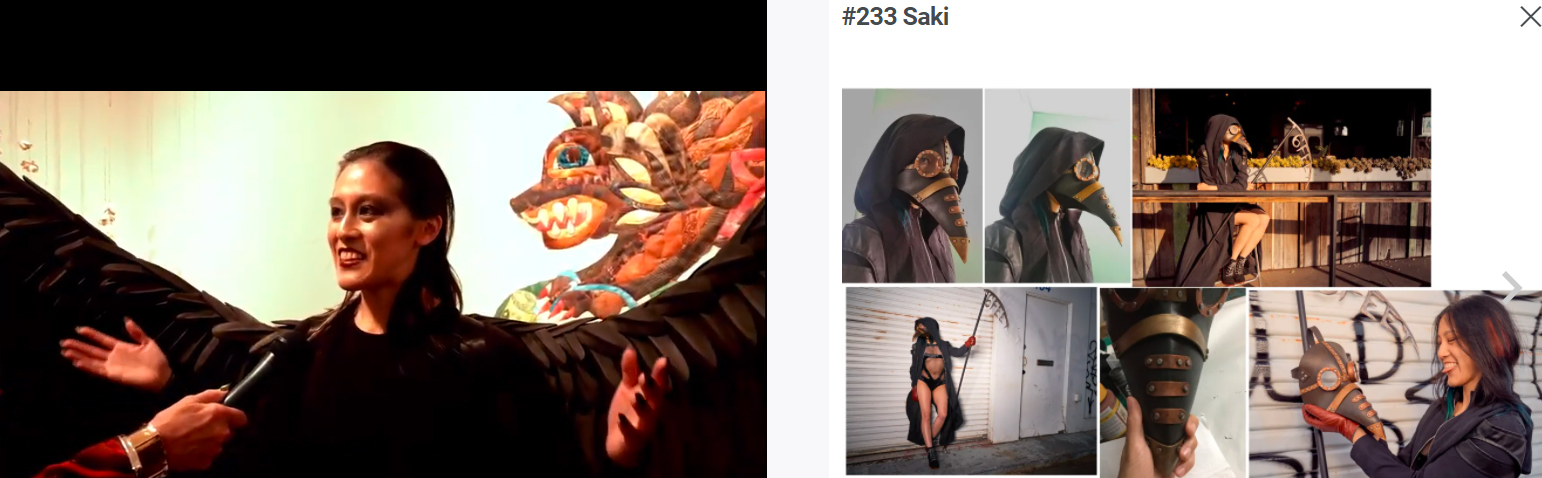
Saki

 by Patricia Frischer


This year as a virtual experience Oceanside Museum of Art decided to go for a full fashion show hosted by Jan Arnold, CND co-founder and style director, and Gwen Bates, Director of Fashion Week San Diego. This pair describes each of the outfits in detail and the pre-party even gave us a chance to meet some of the designers in person. The whole event including the pre-part is archived Night of the Living Art: AnArt After Dark Fashion Extravaganza.


I am writing this while I listen to the after party music with DJ Mandy who is giving us very danceable discs. Until Nov 8, the fashions will all be on display at OMA.  You can vote for the People’s Choice winner ($1 a vote) and the winner will be featured in the coming months in the museum gift store. Plus you can actually  bid on coveted must-haves from the show, almost all of which are available for sale.  


Jan Arnold and Gwen Bates chose a joint winner for the evening Saki and Marty Ornish, who will be given a feature show at OMA sometime in 2021.

 I could not help but remember our own Art Meets Fashion project for San Diego Visual Arts Network in 2011 when we matched artists with fashion designer, teachers to write lesson plans and a documenter to record the collaboration. It is interesting to see that this sort of cross over between art and fashion is still a topic of interest. 

Featuring artwork/fashion by Andrea Antonorsi, Mohammad Aziz, Dia Bassett, Isa Beniston, Diana Carey, Emmanuelle Chammah, Sheri Cohen, John Dillemuth, Mary Foote, Sean-Michael Gettys, Randy L Harwood, Susan Lafica, Jessica Lindzy, Renetta Lloyd, Melissa Meier, Beata Mierzwa, Christiann Moore, Beatriz Mora-Hussar, Stacy Nixon, Jami Oliver, Marty Ornish, Taylor Payne, Fiona Phillips, Claudia Robinson, Jan Rolston, Julio M Romero,  Saki, Lucy Stefanko, Danielle Giudici Wallis, and Danielle Zhang.

Here is a selection of some of my personal choices from the evening. 

Saki

Marty Ornish - co-winner with Saki (above) of the featured exhibition at OMA in 2021

Gwen Bates, Director of Fashion Week San Diego

Jan Arnold, CND co-founder and style director

Melissa Meier, on of the featured artist


Renetta Lloyd


Diana Carey

 Danielle Zhang


Friday, October 30, 2020

DOUBLE VISION: SDMA Spotlights Twins and Filmed Musical Tour of the Museum

 By Lonnie Burstein Hewitt


From the “Mary Ellen Mark: Twins” exhibit: A photograph of Paula Mathis and Polly Mathis Wasdin, 29 years old, Polly older by 8 minutes. (Large-format Polaroid, 2002. Collection of Ken and Jacki Widder. Copyright: Estate of Mary Ellen Mark, Courtesy: Howard Greenberg Gallery)

“Mary Ellen Mark: Twins,” a striking display of photographs of identical twins, is currently the featured exhibition at San Diego Museum of Art (SDMA), on view through March 7, 2021. Created in 2001 and 2002, when Mark took a team of assistants and a large-format Polaroid camera to the annual Twins Days Festival in Twinsburg, Ohio, these portraits reveal the tiny individualities in each pair of twins—and one set of triplets—and are all accompanied by quotes excerpted from the photographer’s interviews with her subjects.

Mary Ellen Mark (1940-2015) was born and raised in Elkins Park, Pennsylvania, which according to Wikipedia—is  known for its varied architectural styles, including early-20th-century homes designed by architects like Louis Kahn. She began taking photos at age 9 and went on to a Master’s in photojournalism at the University of Pennsylvania and a Fullbright Scholarship that took her to Turkey and led to her first book of photographs, “Passport.”

In the 1960s, she moved to New York City and became interested in portraying “strange people who are outside the borders of society." Her photographs appeared in Life, Rolling Stone, The New Yorker, New York Times, and Vanity Fair. She also became a photographer on movie sets, shooting production stills of films like Alice’s Restaurant, Catch-22 and Apocalypse Now. 

The Twins exhibition was curated by SDMA’s Assistant Curator Cory Woodall, who selected 20 of Mark’s 30” x 22” portraits to show their diversity in ages and backgrounds. You can view eight of them on the SDMA website, but for the full experience, it’s best to go to the museum, which is now open again, six days a week. As Woodall pointed out, “It’s so much more interesting to see the photographs live—large-size, with all their detail and clarity—so you can stand right in front of them and really pinpoint the differences in each set of twins.”


 From the “Reflections” film: Twin marimbas in the museum’s Rotunda, played by percussionists Fiona Digney and James Beauton (Gary Payne Photography)

In fact, seeing Mark’s Twins at the museum inspired violinist Kate Hatmaker, executive director of Art of Elan, a group that offers new forms of chamber music to diverse audiences, to create a virtual program inaugurating their 14th season of concerts at SDMA. “Reflections,” an hour-long film showcasing musicians and dancers in four different galleries, is both a response to the exhibit and a musical tour of the museum.

“I was fascinated by the idea of twins mirroring each other,” Hatmaker said. “It reminded me of a line from Rumi: ‘The beauty you see in me is a reflection of you.’ And our film really gives you a sense of the museum’s spaces and the lovely combination of music and visual arts.”

“Reflections” will premiere November 10, along with a live introduction from the museum’s Rotunda by Kate Hatmaker and Anita Feldman, SDMA’s Director of Curatorial Affairs and Education. Tickets to the virtual event can be purchased on SDMA’s website. If you want to share the experience in your own time, you can BYO tickets later; a link will be available starting November 11 at www.sdmart.org.

San Diego Museum of Art, Balboa Park
Tel: 619-232-7931
Open 10-5 daily except Sunday 12-5. Closed Wednesday.
Mary Ellen Mark: Twins” will be on view through March 7, 2021.

“Reflections” Tickets at www.sdmart.org: $5 students, $10 adults. Online Premiere Event November 10, 7-8 pm.

Lonnie Burstein Hewitt is an award-winning author/lyricist/playwright who has written about arts and lifestyle for the La Jolla Light and other local media for over a dozen years. You can reach her at hew2@sbcglobal.net

Thursday, October 22, 2020

Lux Art Institute On AiR: Episode 30 - A Woman's Diaspora and Liminal Spaces Panel Discussion

Report by Patricia Frischer


Lux Art Insittute On Air, host: Guusje Sanders, who is Dutch posed the following topics for discussion. Use  this link to watch the entire zoom seminar.

Migration is losing identity. The time for those who you left behind and your own time, is very disorienting. How do you address the invisibility of immigrants?  How do you define yourself as bi-cultural?
Please comments on Occupation of domestic spaces and women labor
Please comment on Cultural passing when you give up part of yourself to assimilate.
We labeling even within the art world. Can we stop being outsiders? When do we belong?
Can fragmentation be a source of strength for the art? Is there freedom in free fall?
Is the process of speaking, writing and creating about this subject is healing?


Grace Aneiza  Ali,  author and curator: Liminal Spaces: Migration and Women of the Guyanese Diaspora  Book is available for free as a pdf.

The stories of women’s diaspora are usually  told by other so providing spaces for them to tell their own stories or at least your grandmothers and mothers stories is important. Many would go to work in the fancy house, but go home to a shack. Women use their homes to be entrepreneurs. Your home is where you can feel comfortable. She has accepted that she has a life time struggle with the fragmentation. Now has an American passport and that has made it so much easier to have privileges for example travel. Many that she loves don’t have that freedom. That is very jarring. Fragmentation makes you more empathetic as it applies to lots of other things in our lives. Guyana is very poor. You can’t check out books from the library. You have to read books only in the building. The stories in her book need to be shared with Guyanese people and they need to be accessible. There was a grant to make the book free to read online. The women shared their stories and art freely. Please support this project by buying the book.

Claudia Cano


Claudia Cano artist. She created an alto ego to contain both identity stereotypes - rich lady and cleaning lady. This is still happening, cleaning ladies, nannies, waitresses, child care workers are largest jobs for immigrant women. She uses performance art where she is serving food or cleaning to communicate these messages of underpaid and limited opportunities but they are non-verbally conversations and can be uncomfortable.  Cano was a professor and lost all that when she came to the US. She had to start from scratch and only could define herself through her art and educational projects. She creates spaces for students to be validated. She has two bi-cultural, bi-national children and one born in the US. She has to help them by having conversations on these subjects. Do the other want to be US citizens? Why should they celebrate Thanksgiving? They have stopped. Went back to grad school as an older student and had the realization that her accent was as permanent as her color. But the mask of the pandemic makes this even worse as people can’t read her lips and she struggles more to be understood. She wishes sometimes not to have an accent. She has a fantasy of a mouth spray that would take your accent a way. There is a constant duality in her life because of racial profiling.  Sometimes still she is asked if she is a nanny when children hear her speak.

Suchitra Mattai


Suchitra Mattai  Artist. She has lived in many different places and so has a quest to re-constructs the story that is her past: South Asian, Guyanese and American. She creates using monumental sizes by collecting diaspora objects so large that the work can’t be denied. She also makes mixed media portraits to preserve and encourage stories especially of her family. Her grandmother was a farmworker and mother was seamstresses. She is telling her story through the found domestic objects and sewing. There are three continents in three generations in her family which means the Colonial past meets the contemporary present.  There are many levels of fragmentation involved from all these different cultures. There is a mystery about who she is as it is so compiled. She is not completely Indian or Caribbean or American. She is only really comfortable in her own home but looks for reconciliations within her art. She uses very different items and trying to put them together so their work and pair.  Her parents did not naturally share these stories. She had to delve and ask to connect to the past. You want to be a global citizen and also want to keep all those connections alive. There is a strength in freedom to be a global citizen. It allows her to cherish and dissect each of the cultures. 

Tuesday, October 13, 2020

Terra Lawson-Remer in Conversation about the Arts: SD Election for County Supervisors District 3


Notes by Patricia Frischer

One of the missions of The San Diego Regional Coalition for Arts and Culture  (SDRACC) to educate our county elected leaders about the role that arts and culture plays in our lives. These are wide ranging and the conversations that SDRACC held with the candidates for the upcoming elections are a wonderful opportunity to not only inform but to get verbal confirmation of support that might be forthcoming.

The conversation with Terra Lawson-Remer for District 3 was on Oct 13, 2 pm. All the candidates were invited to participate.   Current District 3 Supervisor Kristen Gaspar’s campaign did not schedule a session despite multiple attempts by SDRACC to do so but they will continue to try before the election. Please note: conversations were also held for District 1 – Ben Hueso and Nora Vargas and District 2 – Joel Anderson, Steve Vaus.


The Key Priorities for Arts & Culture in San Diego County

A consortium of arts and culture leaders from throughout the County assessed arts and culture priorities with the County of San Diego and prepared this roster of discussion items, which was presented to all candidates who participated in the Virtual Coffee and Forum.  The intent was to educate and inform the candidates to lay the groundwork for advancing our discussions after the election.  All candidates interviewed express positive support for exploring opportunities outlined in the priorities and questions below.
 

The panelist with Terra Lawson-Remer (many of these are board members of SDRACC) were:
Steve Snyder, Fleet Science Center: SDRACC came into existence when the SD County Arts Council folded to help support funding for the city of San Diego. SDRACC is now county wide. 
Alan Ziter, Arts District Liberty Center: launching ArtWalk 2020 Liberty Station Arts District
Alex Goodman, New Village Arts: budget cut in half
Caroline Nordquist, Mingei Folk Art Museum: Just received a Care Grant
Andrew Utt, Lux Art: t Institute 54% now online outside of SD

Terra Lawson-Remer, candidate for Supervisor District 3: Her opening remarks contained these thoughts. People know that the arts are part of our quality of life, but they don’t realize how much the arts contribute to the economy. The arts are not a luxury. Investing in the arts has a massive affect. She would like to see a more vibrant grass roots artist community to go with the established great museums. She loves Liberty Station and attended Dewey when she was growing up. She likes that it brings a large community together and combines food, parks, shopping, and all the arts. Wants to know how do we do that more widely so it benefits everyone?

County Investment in the Arts
In these times of pandemic and protest, artists and creative industry workers truly are essential as  “second responders” – as catalysts and leaders for rebuilding communities and fostering healing and connection. Would you support countywide investments in nonprofit arts and culture organizations and the livelihoods of artists across our County—especially in unincorporated areas where the County has direct oversight? 

Terra Lawson-Remer: She is going to look to the arts community to tell her what will make a real difference.
She supports a SD County Arts Council (SD County Arts Commission, SD County Office of Cultural Affairs) which could be a vehicle to coordinate and cross pollinate the arts community with other county needs.
She wants to hear about really big ideas that are innovative.
 

Office of Equity and Racial Justice

In the FY21 budget, the County created a new Office of Equity and Racial Justice. As artists and creatives have been at the forefront of social movements to bring about change to dismantle systemic racism and structural inequities, would you support the appointment of artists and creative to that Office—and to boards and commissions where their perspectives would be valued? ​

Terra Lawson-Remer: We need to fight racism and give opportunities and she would be open to appointment of artist in that office. But she states we need more than an office. How do we ensure that we are taking this initiative to every area by being creative looking more deeply? She is voting for Prop 16 but thinks there are challenges to how it is written. We need to do more.

Use the Arts to Advance County public health, housing, public safety, and the environment
The arts have the ability to inspire, uplift, and heal.  Would you support the arts as a solution to move forward other priorities the County has historically invested in: public health, housing, public safety, and the environment? 

Terra Lawson-Remer: She wants to make the arts accessible to everyone especially the young and isolated. She will be looking for big community art projects. She hopes there are public building that could have big art works. She would like to see an Inventory of buildings and needs to see how those unused places could be enlivened and available to all. There needs to be an environment created that can foster the arts.

A special area for Lawson-Remer is child care as the cost now has soared to that of a university tuition. Women need to be able to work and since they are the prime care givers still, this has effects gender issue. Affordable childhood development in day care is vital. How can we create programs where every daycare has ongoing exposure to arts opportunities?  Nordquist joined in to say that Museums in SD are almost all female and pandemic is affecting them. Utt commented that art in the school is not creative enough. How can we work with the county to embed the cultural program in the schools and not have to rely on small funding for only a small part of our young population?

Champion for the Arts
If you’re elected to represent the District, can we count on you to be a Champion for the Arts—to support measures like those we’ve discussed today, to support budgets that make real investment in arts countywide, to support more resources to our county’s artistic community and creative industries? 
 

Terra Lawson-Remer: We will need to get the economy back on track, make sure there is a vaccine and invest in public health, and get the kids back in school.  The arts are not a silo need but a part of the strategy to get going again.

​Countywide Arts Council
As the second most populous county in California, San Diego does not have a countywide arts council—unlike Los Angeles and Orange.  As County Supervisor, would you support the County taking a more active role in policy making and in investing in arts and culture for our region?

Terra Lawson-Remer: Most of the county policies are stagnant and that includes the arts policy. No initiative has been taken. We can look at other counties arts programs which are affective and visionary and work from there. We have to invest in the arts. A County Arts Council could combine the needs between lots of agencies. Office of Cultural Affairs is over-due. The Arts are an important pillar of the community.  

Lawson-Remer asked where does the funding for the arts come from? Ziter answered that there is no real large corporate funding here now or even much foundation help, so it is individual donation and county funding we rely on.  The wealthy often still give in their cold weather home town. It is twice as hard to raise half as much here in San Diego. Terra Lawson-Remer said that we need those funders to invest here and the county needs to invest in the arts.


Saturday, October 10, 2020

Local Filmmaker Couple Shine in San Diego International Film Festival


By Lonnie Burstein Hewitt 

PHOTO: MAKING LEMONADE: OUR COVID-19 STORY (Courtesy)
See On-Demand Screenings October 15-18 at San Diego International Film Festival


This is the 19th anniversary of the San Diego International Film Festival and from October 15-18 they’ll be screening 114 films from around the world, most of them San Diego, West Coast, U.S. or World Premieres.

But this year, it’s a whole new game, with rules determined by Covid-19. Besides online live-streaming and on-demand screenings and special events in a Virtual Village, there will be four Drive-In Movies in a parking lot at Westfield UTC, for film-lovers eager to get out of their living rooms and back to a big screen.

A number of the films—which include feature-length and short-form dramas, comedies, documentaries and animations—are about ch-ch-ch-changes and involve dealing with difficult situations and creating new beginnings. And considering how many of our changes this year have been Covid-related, it’s interesting that one of the most affecting films is done by a San Diego couple who were both infected by the virus and decided to make something good out of their experience.

Like many of us, Chris Francis, a documentary filmmaker, and his wife, Krista, an office manager for FitBit, were leading an active and pleasant life until one Friday evening in March, when she noticed she’d lost her sense of smell. Not only that, she couldn’t taste anything: a raw onion tasted the same as yogurt; only the texture was different.

She did some research online and found a few studies suggesting that these symptoms were a side effect of the new virus. That Monday morning she was tested; two days later she learned she was positive. It turned out Chris was positive too.

“At night, when I went to bed, I’d start coughing, and I just couldn’t stop,” he said, when I spoke with him recently. “It’s been seven months now, and I still have a little cough. Krista has some of her sense of smell back, but only about 10 percent of her taste.” 

They started quarantining, not doing much of anything except keeping away from other people, trying to get better and not worry about whether they might get worse. Thankfully, they didn’t have to be hospitalized.

“Since I was a filmmaker stuck at home in a one-bedroom apartment, I figured I’d document our story as it happened,” Chris said. “It would give me something productive to do.” 

He decided to highlight some of their lighthearted moments and also show how they found ways to make themselves useful, by participating in Covid-related research studies. What happened to them was, as Chris says, “not the funnest thing in the world,” but the film has turned out very well. Its title—MAKING LEMONADE: OUR COVID-19 STORY—indicates that the couple not only tested positive but kept up a positive attitude. Now it has brought them awards in L.A. and Las Vegas, and been hailed as moving, inspirational, and often surprisingly funny. You can see for yourself in on-demand screenings anytime during the four-day festival.

Two other films you won’t want to miss, both about life-changing journeys:

 NOMADLAND, the Festival opener, has already won major awards in Venice and Toronto. It stars one of my favorite players, two-time Oscar-winner Frances McDormand (“Fargo” and “Three Billboards Outside Ebbing Missouri”) as a 61-year-old woman who loses everything and takes off in her van to find work on the road. Appropriately, this is a Drive-In Movie: Thursday, 10/15, 6:30 p.m.

 150 MILLION MAGICAL SPARROWS is a compelling Indian film about a 9-year-old girl’s search to find and free her “disappeared” 7-year-old brother. (On-Demand Screenings) 

With 114 movies to choose from, it’s hard to believe you won’t find something completely different from what you’ve been watching on Netflix. For full program and tickets go to www.sdfilmfest.com  

Lonnie Burstein Hewitt is an award-winning author/lyricist/playwright who has written about arts and lifestyle for the La Jolla Light and other local media for over a dozen years. You can reach her at hew2@sbcglobal.net