Saturday, October 9, 2021

Kumeyaay Pictographs, Petroglyphs & More, by Don Liponi, Ph.D., Imperial Valley Historical Museum

 By Patricia Frischer


Don Liponi, Ph. D., Imperial Valley Historical Museum, member of the Kumeyaay Education Council and Instructor, Kumeyaay Internship Program was our guide and the photographer for a lecture on rock images. The spiritual communications of the Kumeyaay and Tipai Native Americans are recorded in their pictographs (mineral based paintings on rocks) and petroglyphs (carvings into the rocks). Even though many of these images have seemed to disappear, there is a new DStretch technology that makes it possible to see these works using your digital phone with a special app. 

There has been a cultural genocide of the Kumeyaay way of life but the prehistory and ancient history of the Tipai Shaman records a life harmoniously with nature. This tradition of ancient art is called La Rumorosa, after a site in northeastern Baja, Mexico. These photos record first some geometric shapes and the shape of a man, then a half man/half animal and animals that were guide for the Shamanistic hallucination travels and finally man transformed/ with geometric shapes.

I found these images so compelling and the idea of understanding more about native American Shaman fascinating. These seemingly very basic images which we think of as the foundation of primitive art, may after all be much more sophisticated and be a conduit to living a more wholistic and balanced life. This is just a taste of the lecture sponsored by Mira Costa’s LIFE so make sure and watch it for yourself as it is available until the end of the year. 


Don Liponi


Thursday, October 7, 2021

New Sculptures Enliven the Streets of Del Mar

 By Lonnie Burstein Hewitt. Photos by Maurice Hewitt.

Moonshadow, by Jeffrey Laudenslager & Deanne Sabeck, one of the new temporary outdoor sculptures now on view in Del Mar. See it on the northeast corner of 9th Street and Camino del Mar—bright sunshine makes it look even better—and don’t be afraid to touch it gently and change the way it moves.  

If you haven’t strolled through Del Mar lately, now is a good time to go. Since the City of Del Mar established a public art policy and created an Arts Advisory Committee, there’s been an upsurge of artful activity here, with the Del MarFoundation stepping in to underwrite the costs of the newest installations: five sculptures between 9th and 15th Streets.

They’re all by contemporary local artists and will be on view for the next 23 months, and they’re all for sale… but must stay in place for a minimum of 12 months.  Then if sold, a fresh piece will be selected to replace it for the duration of this exhibit.  We recently got to see them and some of Del Mar’s more permanent public artworks with Naomi Nussbaum, who was engaged by the Del Mar Foundation to oversee the Temporary Outdoor Sculpture Program almost two years ago.  

A sought-after art consultant who lived in Del Mar in the late 1980s, Naomi Nussbaum is also executive director of Synergy Arts Foundation, a non-profit dedicated to supporting local artists and arts organizations. When pandemic lockdowns made in-person interaction impossible, she put out an online call to artists and received 41 submissions, which had to be passed on to a subcommittee before making their way to the Arts Advisory Committee, who made the final five choices and selected their sites.

Terpsichore, by David Beck Brown. (SE corner of 12th Street & Camino del Mar)


Bird’s Eye View of Torrey Pines Beach, by Robert Petrello & Drew Graham. (SE corner of 14th Street & Camino del Mar)

Pasaje a lo Infinito, by Hugo Heredia. (15th Street, west of Camino del Mar)

Hanging Out #3, by Maidy Morhous. (15th Street & Stratford Court)


Here are a few of the permanent artworks we also enjoyed seeing on our walk: 

Outside the Del Mar Library, on 13th Street & Camino del Mar: Baby Boomers Google! —a bronze, apple-topped bookstack by Maidy Morhous, with a partial view of the grand mosaic mural created in 2002-2003 by Betsy Schulz and Pat Welsh with the help of community volunteers.

Yet another bronze by Maidy Morhous, originally submitted to the Temporary Sculpture Program, which only allowed one piece per artist to be chosen. It was immediately purchased by Del Mar Plaza owner Marc Brutten and now has a prominent place on the top deck of the Plaza, as part of its Public Art Collection.  

“This Temporary Outdoor Sculpture Program was a pioneering project for Del Mar and I think it’s a great start,” Nussbaum said, after we’d seen the artworks and were comfortably seated on the Plaza’s upper deck. “I hope the City of Del Mar will embrace more public art since there are so many potential sites here and it will not only enhance the cultural life of local residents, but also increase cultural tourism.” 

To make it easier for you to tour Del Mar’s public artworks on your own, here’s a map, created by the Del Mar Foundation.  Enjoy!

Del Mar Art Walk Map

Lonnie Burstein Hewitt is an award-winning author/lyricist/playwright who has written about arts and lifestyle for the La Jolla Light and other local media for over a dozen years. You can reach her at hew2@sbcglobal.net

Saturday, October 2, 2021

Full Circle but with No Center: Doris Bittar lecture

 By Patricia Frischer


Doris Bittar is a local artist that loves patterns and decorative motifs. She just doesn’t reproduce them, invent them and display them, she also researches them. In this lecture, she shared her belief in the evidence of how patterns can trace the paths of cultural development. Patterns are shared, changed and evolve. The title of this lecture, The Silk Road and Its Arab Milieu, part of the China³ series of the San Diego Chinese Historical Society and Museum and SDSU Chinese Cultural Center is just a starting place for her exploration of the influences of the Arab community, and on this community by Egyptians, Asians and western civilization.

We are shown patterns as calligraphy, lattices, screens, rugs, facades as they crisscross across the millennia and around the world.  This cross cultural exchange shows how uncentered in one place these belief really are. The ebb and flow and understanding this might help us to decentralized our own beliefs.  

Doris Bittar was born in Baghdad, Iraq to Lebanese and Palestinian parents who immigrated to New York. She received her BFA from the State University of New York and her MFA from the University of California, San Diego. She taught at the UCSD, the American University of Beirut, among others and was a visiting scholar at New York University in 2017. She is a member of Arab Amp, and a founding member of Gulf Labor.

I recommend that you watch the recorded zoom lecture. That will help you connect the dots of these images.


Egyptian Pyramids and Arab Mosques


Chinese doors and Muslim pattern tools

Mosaics from Rome and the Byzintine

Early tapestries influence modern designs

Arab screens

Details of handmade spindles used in screens

Varieties of patterns used world wide


The calligraphy is actually figurative and based on proportions. It is a myth that Muslims disallow depictions of humans, animals, and nature. 

Calligraphy as landscape.


Modern testimonial to the Dump people of the world . Elseed’s Perception  Anyone who wants to see the sunlight clearly needs to wipe his eye first.


A full cycle, the whole body used to carry forward the calligraphy tradition. 


An artwork by Doris Bittar. "Tarab Soundings"  2010 -2014


A Grand Opening in Balboa Park: Unity and Variety at the New ICA Central

By Lonnie Burstein Hewitt.  Photos by Maurice Hewitt.


A partial view of the eye-catching neon piece that ushers you into Unity and Variety.

For months, we’ve been looking forward to the opening of the Institute of Contemporary Art San Diego (ICA) —the new collaborative entity formed by Lux Art Institute in Encinitas (now ICA North) and SDAI (now ICA Central) in Balboa Park.

Chosen to create ICA’s first exhibition is Mexican artist Gabriel Rico, whose work has been shown in museums and galleries around the world and included in the 2019 Venice Biennale. Another first: this is Rico’s first solo show in California.

And it’s a great debut—a seriously engaging installation that is both spacious and loaded with interesting details. With his Unity in Variety  theme, Rico appropriately expresses the emphasis on diversity embraced by ICA, and uses a mix of organic and manmade materials like neon, TV screens, twigs, sand, steel rods…and lots of stuffed wildlife provided by the Natural History Museum (The Nat, just a short stroll down the Prado) to create a surreal environment that invites consideration of the mixed relationships we have with our natural environment—specifically, the one around San Diego.


A partial view of the exhibition, with a feather-hatted, mirror-ball-headed, neon-lit-sheet-clad sculpture in the foreground.

There are no informational labels on the mostly anthropomorphic sculptures. Andrew Utt, ICA’s founding Executive Director and the organizing force behind the exhibition, explained why: “We see this as an immersive installation, so we don’t think of them as individual pieces. It’s a complete experience on multiple levels.”

So it is. And the titles of some of the pieces—like “Fish begin to stink by the head”—might tend to lead one astray. But here are a few of our favorites from that series—and what they’re made of:


TV screen, corrugated steel rod, hand-painted ceramic, rope, seashell, volcanic rock, neon and metal.

Found objects, neon, gold leaf, concrete, popotillo grass and a bamboo stick—with a taxidermied coyote from The Nat standing nearby. 

TV screen, firefighter jacket, corrugated steel rod, hand-painted ceramic, brass, neon, mirror, coins and plastic figures. 

Closeup of the firefighter’s TV-screen head.

Besides the grand neon overhanging the gallery, the artist includes neon in more than a few of his sculptures. “Neon represents invisibility versus the tangible,” Andrew Utt told us, as he walked us through the exhibition. “It’s a gas, so when it’s turned off, you can’t see it.”

He pointed out something else we hadn’t noticed, about the hanging neon: it’s all based on fives—5 fingers, 5 senses, 5 numbers, 5 vowels.  If you’re eager for information like this about any of the pieces, just ask one of the EGs—Engagement Guides—in the gallery. That’s what they’re there for.

There are no boundaries in Unity and Variety, though it has much to do with our border, that un-natural boundary created to divide and control. That’s not how Gabriel Rico sees things. “The entire ecosystem from Baja California, Sonora, and California works together like a unity,” he says. “Fish can cross the border, so do mammals and insects.”

But there are always invisible barriers—the dead birds in one piece didn’t make it; they crashed into a glass wall. And there are things littering Rico’s sandy beaches, the detritus of our consumerist culture—an Oreo cookie-box wrapper, a discarded towel, Coca-Cola bottles. 

Taxidermy birds, Coca-Cola bottles and popotillo grass on sand.

A number of the sculptures have TV-screen faces—do take the time to watch at least portions of the videos. And check out the gold-leaf “leaves” attached to some twigs: if you wave at them, they’ll move in the breeze you create. And here’s one last piece from the “Fish” series: this powerful one has a powerful name—Tsar Bomb.

TV screen, corrugated steel rod, plastic skeleton, kimono, volcanic rock, hand-painted ceramic, tin can, plastic dice, fake banana, orange and plant. Tsar Bomb was the most powerful nuclear bomb ever created, developed in the USSR and tested in October 1961.

On a lighter note: definitely ask an EG for the coyote-led tour of Unity and Variety, a short Augmented Reality video you can access on your own smartphone or borrow a tablet from the front desk. It’s a trip letting the AR Coyote be your guide—we did it twice.

 And definitely don’t miss this exhibition. It’s a winner in all ways…and admission is free!

 Unity and Variety, on view through January 23, 2022 at ICA Central
1439 El Prado, Balboa Park
Thursday-Sunday, 12-5 p.m.
619-236-0011/ icasandiego.org

P.S. You may also want to check out Gabriel Rico’s accompanying installation to Unity and Variety at The Nat, on view in their Unshelved exhibition space through January 23. The Nat is open Friday-Tuesday, 10-4, with admission ranging from Free-$19.95.  

I’ll be writing about the Christine Howard Sandoval exhibit at ICA North in Part 2 of this ICA story, coming soon.


Lonnie Burstein Hewitt is an award-winning author/lyricist/playwright who has written about arts and lifestyle for the La Jolla Light and other local media for over a dozen years. You can reach her at hew2@sbcglobal.net.

Friday, September 24, 2021

Seeing the Invisible at San Diego Botanic Garden, Encinitas

by Patricia Frischer


El Anatsui - AG + BA (AR) The shadow of the rock and the slight lifting of the drapery as if disturbed by wind in this work make it truly magical. Don't forget to walk up close to see how pieces of aluminum or tin are joined with jump rings making this such an impressive piece of recycling. 


San Diego Botanic Garden (SDBG) in Encinitas is “showing” artworks created to enhance the real physical world. This augmented reality (AR)  exhibition Seeing the Invisible  includes works by 13 artists:  Ai Weiwei, El Anatsui, Mohammed Kazem, Sigalit Landau, Mel O'Callaghan, Isaac Julien CBE, Sarah Meyohas, Daito Manabe, Timur Si-Qin, Jakob Kudsk Steensen, Pamela Rosenkranz,  Refik Anadol, and Ori Gersht. 

This means that as you wander through this exquisite garden, you use a smart device and the invisible becomes visible. Some of the artists present moving images, others images that you move through and around. Sound is supplied to enhance and sometimes challenges you. The garden supplies smells and touches of wind and sun. No I didn’t eat any of the fruit I saw, but it was tempting to make this a fully 5 senses experience. 

Nothing about this was static as you had to participate to get the full effect by moving your body and even interacting with others on the site. A few of the works were scary, others were meditative but they all involved you with a surprise of some sort and many engendered questions.

I know this was not intended to be a Halloween specific display, but put it on your to-do list of haunted properties. And go with friends and family, if you can, as like going to the movies in a real theater, the audience adds to the thrill. 

This show will premiere across 12 gardens in six countries simultaneously in September 2021 will be available for a whole year until August, 2022. So in our local venue the works might be seen in a coastal setting but somewhere else it might be in a forest. It is co-curated by Hadas Maor and Tal Michael Haring organized by Jerusalem Botanical Gardens and Outset Contemporary Art Fund.  At SDBG, the president and CEO Ari Novy started this process one years ago, but SDBG was lucky to hire Senior Director of Education and Visitor Services Tomoko Kuta who joined the staff in April and helped to plan each location for optimal viewing. 

Besides investigating the subjects of each of the works, this is a chance to explore the interplay of the physical world with the digital one. It aims to present nature AND digital instead of nature versus digital.

You need a smartphone or tablet to experience these work available to download from Apple App or Google Play App. The exhibition is included in the price of admittance to the gardens and free to members. If your device is not enabled, you can borrow an iphone from SDBG on a first come first serve basis. 

My great thanks to Lourdes Munoz  who escorted me around the display and to Ashley Grable who set up my tour. 

Ari Novy on his World of Bromeliads throne


Ai Weiwei - Stoll through a Gilded Cage with turnstiles which makes that familiar sound as you ratchet around the space.  Look up and yearn for freedom. Or consider yourself safely cocooned from the outside world but with a view. 

Sigalit Landau  - Salt Stalagmite #1 [Three Bridges] Walk all away a round this mountain of miniature waterfalls and moats, hear the water and glide over arches avoiding the barbed wire. This work is based on the idea of salt bridges from the Dead Sea serving to connect warring factions in the Middle East, resulting in peace. 

 
Mohammed Kazem - Directions (Zero) Sited on a dramatic overlook, this enormous zero looms up and over you but peer closely to see the writing on the surface are location of every country in the world. And visit often to see the ever changing color. 

 
Isaac Julien CBE - Stones Agaist Diamond is a slow walk through ice caves in Iceland. All side of these five screens are changing and relating to each other and you as you encircle the work. Slowly the images change, and overlap with your movement. The beauty of the ice is revealed as precious as diamonds. 

Mel O'Callaghan -Pneuma One of the most powerful of the works, this globe distorts your view of the bamboo where it is sited, But as you can move inside the image, the heavy breathing and pulsing of the shapes becomes truly ominous. 


Daito Manabe - Morphecore Prototype AR Does this figure look stilted? Just wait to  see him start to dance and as the frenetic pace increased, his limbs are more and more disjointed. Add to that, you can walk right through him and the pixels start to dissolve and then re-align.  The artist extracted MRI scans of his brain and used this raw data to determine the digital movement. 

Jakob Kudsk Steensen - Water Serpent Sorry not to have a better image of this wicked piece of dried out cactus with a giant coiling snake eye that is almost obscene as it follows where ever you go. The artists states that it has "positive spirits and omens of life." You decide, but sounds of water where they is none does give pause. 

Ori Gersht - Forget Me Not Yep, it looks like just a 17th century Dutch vase of flowers, but then as you come close, it explodes with a loud noise (big bang theory) and the individual flowers, petals, leaves, glass and insects are shot into the air and then float down. Makes you think about the state of our own environment. 

Pamela Rosenkranz - Anamazon (Limb) This ghoulish green limb grows out of a real bright green leafed plant, but looking closely at the base, you can see a weird green glop dripping onto the ground. Shades of the Wicked Witch meets Little Shop of Horrors as this could be plant or human arteries and veins.  

Refik Anadol - Machine Hallucinations: Nature Dreams AR This abstract painting comes to life, pulsing as if the artist's paint was alive and trying to escape the frame. The colors are beautiful and the shapes enticing. But the algorithm that generates this work is based on natural images. (68,986,479 million of them)!

Sarah Meyohas - Dawn Chorus A simple grand piano playing itself with keys moving and string vibrating but then the blue birds (of happiness?) whips through the scene. When I changed my stance I came face to face with one of these creatures. These birds are what I imagined Cinderella's seamstress birds were like as they outfitted her for the ball.  Are the birds conducting the music or is the music orchestrating the birds movement?


Timur Si-Qin -  Biome Gateway It is hard to remember you are standing in the middle of a parking lot as you enter this dark cave with florescent cave drawings on the walls. Suddenly a ellipse of light beckons you forward and you find yourself outside under a star filled night. Nope, it is still sunny and bright in the real world, but this is a strong shift in perspective.  

Some helpful tips to make the most of your visit:
  • If you have not been to the Botanic Garden recently, there is a new entrance which is just a few block north from the old entrance. It is well marked and you park in a lot right next to the Dickenson Family glass conservatory. 
  • When you download the app, swipe up to start, try to find the signs for each of the AG sites. The little blue direction cones help to orient you to the right direction.
  • Put your sound level on high for the best experience. 
  • The app will let you know when you are there and then follow the prompts.
  • Try centering at different points of the same work especially if the sun is in your eyes.
  • Move around and even through the works, Look up and down and go up close.
  • If you smart device is not accepeted, borrow one of the loaner phones (which I had to do).
  • Go back again on a day with different weather as the background is so much a part of the experience and the AG is available until August of 2022.
  • Take water with you and make sure your device is chargedh!
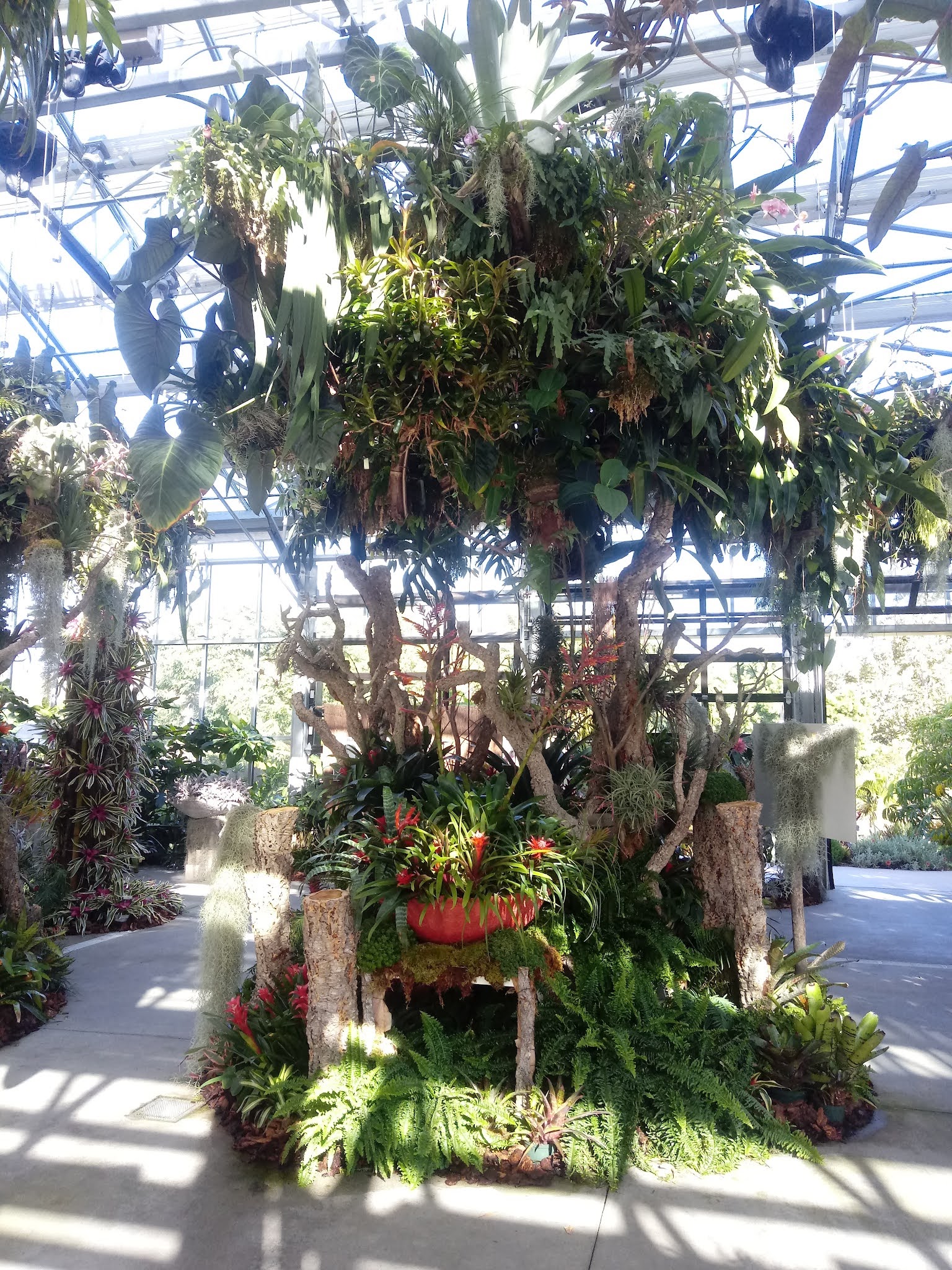
Here are a few bonus images of the World of Bromeliads which was in the new Dickinson Family Education Conservatory. 

A wonderful tower of Bromeliads.

This wonderful new space can be used for all sorts of events. When the Bromeliads are gone, the large overhead displays can be lowered to fill the space or stay high to accommodate a large crowd. What a beautiful venue for a wedding!


300 Quail Gardens Drive, Encinitas, CA 92024
Wednesday - Sunday 9 am - 5 pm (Closed Christmas)
Admission charges vary
760-436-3036 x231

Want more digital exhibitions: Digital Me opens to the public on Saturday, October 9 at the Fleet Science Center through January 9, 2022 and was created by Amir Schorr, produced by Madatech: The Israel National Museum of Science, Technology and Space. It lets you track your digital footprint in the world with over a dozen larger-than-life exhibits covering geolocation, facial recognition, Artificial Intelligence, computer vision, data privacy including some wacky Insta-filters.