By Lonnie Burstein Hewitt. Photos by Maurice Hewitt
 |
| As
a toast to museum and gallery re-openings, here’s Liqueur, one of
the amazing colored-pencil drawings by Madrid-based artist Ana de Alvear
at San Diego Museum of Art. |
If you're zoomed out-and who isn't after 16 months of home-screening the arts?-now is the time to start getting out and about to see art the way it was meant to be seen: in person, at your favorite re-opened art-filled venues.
Here are some exhibitions you can enjoy this summer. In all cases, keep a sensitive distance from others and prepare to wear masks as required.
SAN DIEGO MUSEUM OF ART
SDMA has a trio of new exhibits on view. The first, small but mighty, is Paintings from the Confinement, featuring pandemic-time artworks and musings by Marianela de la Hoz. Born and raised in Mexico City, Marianela began making art in early childhood and moved to San Diego with her husband, two children, five cats and two dogs in 2002. Somewhere along the way, she fell in love with 15th-century Italian paintings and adopted the labor-intensive medium of egg tempera as her own, lacing her brilliantly-detailed, story-telling pieces with her distinctive brand of dark humor.
 |
Global
Coup d’Etat.
Of
this striking painting, Marianela de la Hoz says: “I had to represent the
Coronavirus as a character. In my mental archives, she appeared as a
crowned skeleton, reminding me of the Carmelite nuns who were crowned with
flowers when they took vows to renounce the world, and again when they died. Is
this a man or a woman? Dead or alive? The
virus isn’t stable; it changes. And we all renounced the world.”
|
There’s a profusion of tiny but significant details: the crowned skeleton is wearing men’s shoes, unlike Carmelite nuns, who go barefoot. There are weeping tears on the tablecloth, but with a skeletal hand, the virus has drawn a protective circle around the child—the artist’s son at age 3—since children are not generally affected by coronavirus. And although there’s a death’s head beside the globe, there’s a corona of blooms and butterflies around it. “Our children are inheriting a wounded world,” says the artist, but maybe nature was grateful for human seclusion.”
 |
In “Natural” Selection, We Lost One
Dimension.
“Even
before the pandemic, I was thinking about how we’ve changed our way of life,” Marianela
says. “We’ve become these cookie-cutter people, so much less individuality, all
our images coming from screens.” |
In
the next gallery, there were more surprises: we were blown away by Everything
you see may be a lie, still-lifes that look like oil paintings but were
actually drawn with colored pencils. We were lucky enough to run into the
Madrid-based artist, Ana de Alvear, who had come to town for the June 19th
opening of her exhibit and was about to return to Spain.
“Since
I was 12, I’ve been fighting to change the idea people have of colored
pencils,” she told us. “This is not a minor technique!”
She’s
found ways to facilitate that change, by making the drawings in such a way that viewers
experience them as paintings or photographs, or sometimes making them very
large-scale. Her two galaxy pieces here are each 3 meters by 7 meters—that’s almost
10 by 22 feet! It would be hard not to take them seriously.
 |
Size
Matters: Ana
de Alvear with In
the Forced Vortex (Black), her “black hole” piece.
|
“I
invented these galaxies!” she said. “They’re mine! And they’re valid, until
some scientist can prove that they’re not!”
Fifty
colored-pencil drawings went into her black hole piece, which
took a year to complete, not counting the years of creative thinking that preceded
it. Each individual drawing is tacked onto the wall with a magnet and a push
pin; the things that look like tiny stars are shiny magnets, and this black
piece, like all her others, was done on white paper.
“I
cook my own colors,” she explained. “Sometimes I have eight colors on top of
each other.” It’s impossible to get a real feel for her artworks in photos.
You’ll have to go see for yourself.
The next exhibition,
by far the largest, brings you back in time to Western Europe from 1500-1800—the Renaissance to the
Rococo. Cranach to Canaletto: Masterpieces from the Bemberg
Foundation is part of an impressive collection assembled by Georges
Bemberg (1915-2011), an Argentine/French writer who bought his first painting
as a student at Harvard. Currently housed in Toulouse, France, this is their
first public showing in the United States. It’s also a lovely opportunity to
recognize the influence of their techniques on the artists in the two previous
galleries.
 |
| Portrait of a Young Woman, by Lucas Cranach the Elder, dated 1525-1530. |
After
viewing these new exhibitions, be sure not to miss the permanent collections, which
now look better than ever. And perhaps consider lunch at the museum’s plein-air
restaurant, Panama 66, and a stroll through the Sculpture Garden.
San
Diego Museum of Art
1450
El Prado, Balboa Park
San
Diego, CA 92112
(619)
232-7931/www.sdmart.org
Hours:
Monday-Saturday, 10 am-5 pm. Sunday,12-5.
Closed Wednesday.
Admission:
Free-$15
MUSEUM
OF PHOTOGRAPHIC ARTS
From SDMA, it’s just a short stroll down El
Prado to the Museum of Photographic Arts, where there’s an eclectic showing
of works made by famous and not-so-famous photographers when they were still
under 35 years old. This Beginnings, Forever exhibition, from the
Kiyosato Museum in Japan, has just been joined by the works of photographers half
that age and younger in MOPA’s 15th Annual Juried Youth
Exhibition: Darkest Nights, Brightest Stars.
These yearly exhibitions featuring K-12
students from San Diego and Tijuana are always delightful, and the talents of
some of these 5- to 18-year-olds are staggering. This time around, due to
pandemic closures, there are two years on display—138 chosen from almost 1,000
submissions. And there are two different themes—Growing Up (2020) and Space
(2021)—which the young photographers were free to interpret in whatever way
they liked.
Here are two of our favorite pieces from Beginnings,
Forever, both revealing the expressive powers of artists at age 27. They’re
followed by two from the Youth Exhibition, both revealing a level of
artistry beyond their years.
 |
Man and Woman #20, a 1960 gelatin silver print by Japanese photographer Eikoh
Hosoe. |
 |
| Interpreter, a 2001 gelatin silver print by Czech photographer Vojtech
V. Slama. |
 |
| Growing Up in the Middle of Pandemic, by Katelyn Li, age
9, Ocean Air School. |
 |
| The Space Between Us, by Cali Liu, age 18, La Jolla High School.
Cali writes: “This photograph of my mother’s and grandmother’s intertwined
hands after receiving the vaccine gives me hope that the spaces between us will
soon disappear.” |
There’s much to admire at MOPA these days,
and admission is free, so now is a great time to drop in.
Museum
of Photographic Arts
1649 El Prado, Balboa Park, San Diego
(619) 238-7759/ INFO@MOPA.ORG
Summer Hours: Friday-Sunday 11 a.m.-4 p.m.
Free Admission/ Pay what you wish
ATHENAEUM
MUSIC & ARTS LIBRARY
 |
| Marking Time:
What Athenaeum Artists Create in Quarantine |
This is what’s happening in La Jolla: an exhibition of 49 artists who have had solo shows at the
Athenaeum or designed program covers for one of their concert series. Each
artist is showing one or more pieces created in Covid-time, all are for sale, the
exhibit runs through July 31, and there will be a special reception July 9,
6:30-8:30 p.m.
 |
Les
Petites Bee Tiles, by Irene de Watteville. Porcelain bees with
majolica glaze. |
 |
| Collage
(1-6), by
Ellen Salk. |
 |
| Loft, by Lael Corbin.
A series of 35 wooden pieces made from basswood scraps left over from a show he
did here in 2018. See one of his wooden airplanes on display in the adjoining
Reading Room. |
 |
| Perspectives
2020, by Marcos Ramirez
ERRE. Automotive paint and rust on aluminum; wooden
chair. Photo by Lidia Rossner. |
 |
Detail: Perspectives
2020, by Marcos Ramirez
ERRE.
Automotive paint and rust on aluminum. |
Athenaeum
Music & Arts Library
1008
Wall Street
La
Jolla, CA 92037
(858)
454-5872/www.ljathenaeum.org
Hours:
10 am-5:30pm, Tuesday-Saturday. Closed Sunday & Monday.
Free
admission.
OCEANSIDE
MUSEUM OF ART
OMA
currently has six exhibitions on view—all well worth seeing. Particularly
notable is the second-floor Color of Sound, which includes paintings,
drawings, weaving and sculpture by 14 artists on the autism spectrum. It’s
curated by The Art of Autism, a nonprofit organization, and the title
refers to synesthesia—a condition in which senses combine and cross
over, so music, letters or numbers may be perceived as different colors.
 |
| Gorgon
Mozart, by
Austin John Jones. |
 |
| Randomosity, by Syance Wilson. |
Here’s
the link to a fascinating hour-long video featuring four of the artists in the
exhibition—all on the autism spectrum, two only able to communicate with the
aid of speech-enabled equipment. All four express themselves with enlightening
words about their lives and artworks, so you might want to watch this before
your visit. https://www.youtube.com/watch?v=pruHNqIU_Rc
In the small galleries framing Color of Sound
are works by Taylor Chapin and Kevin Vincent. We really enjoyed
Chapin’s room-sized grocery store installation Consumption Capital,
and Vincent’s two wood-and-rope assemblages are interesting too. Then there’s Botanical
Hybridity, a series of bright-colored oil paintings by Amanda
Kachadoorian representing San Diego’s multicultural flora.
 |
| Consumption Capital, by Taylor
Chapin. |
Back down on OMA’s main floor are 39 eye-catching and
thought-provoking paintings by Mark Bryce, all
on the theme of Love & War.
 |
| War, by Mark
Bryce. |
 |
| Portrait of the Artist by Mark Bryce |
After contemplating Love & War, you can move
on to Twenty Women Artists: NOW, a “collective reflection on the
challenging conditions women face today” by a San Diego-based artists
collective. You’re sure to find your own favorites here; here’s one of
ours.
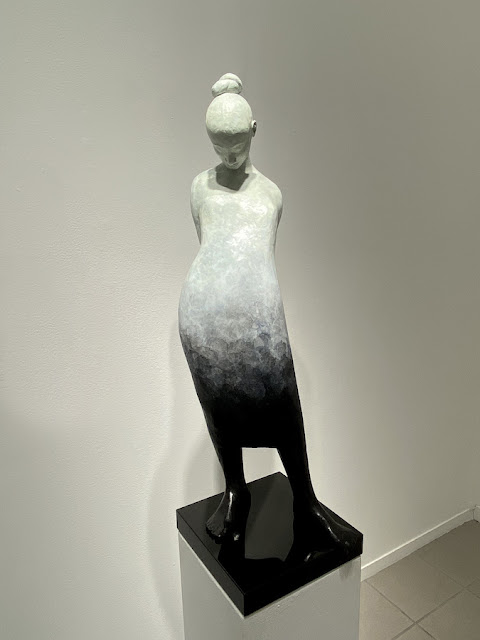 |
| Missy,
bronze sculpture with granite base by Manuelita Brown. |
Oceanside
Museum of Art
704
Pier View Way, Oceanside CA 92054
(760)
435-3721/www.oma-online.org
Hours:
Thurs-Sat, 11 a.m.-5 p.m.; Sunday 11-4.
Hours
are subject to change, and some exhibits end
soon; confirm hours and end-dates before going.
Admission:
Free-$10.
Lonnie Burstein Hewitt is an award-winning
author/lyricist/playwright who has written about arts and lifestyle for the La
Jolla Light and other local media for over a dozen years. You can reach her at hew2@sbcglobal.net


