Saturday, December 4, 2021

The Story of the Chinese Cultural Revolution Told Through Ceramics

by Patricia Frischer


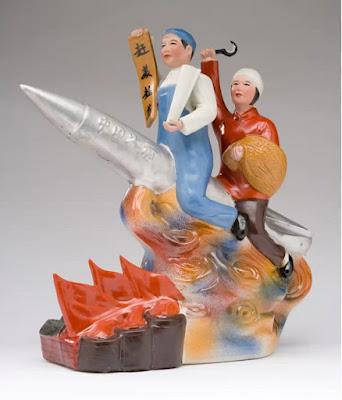
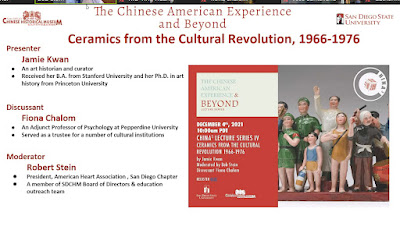
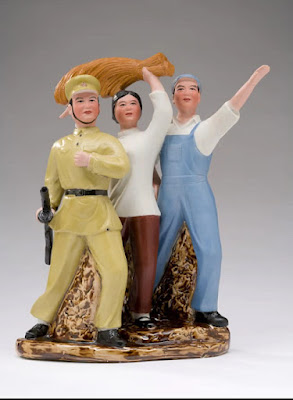
 These really amusing ceramic sculptures are not meant to be a joke. They are Mao Zedong’s way to try to control his cultural  revolution from 1966 to 1976. These works are  from an upcoming show opening Jan 3 as a collaboration of the Chinese Cultural Center and San Diego Chinese Historic Museum put together by Fiona Chalom, Ph.D. Adjunct Professor of Psychology at Pepperdine University and private practitioner, Li-Rong Lilly Cheng, San Diego State University and director of the Chinese Cultural Center at SDSU, and  the chair of the board of directors at the San Diego Chinese Historical Museum and Jamie Kwan, Ph.D. Princeton University, curator and art advisor based in Los Angeles. 

Jamie Kwan gave this talk The Story of the Chinese Cultural Revolution Told Through Ceramics and explained so clearly the motivations and quirks about this body of work mainly collected by Fiona Chalom. 


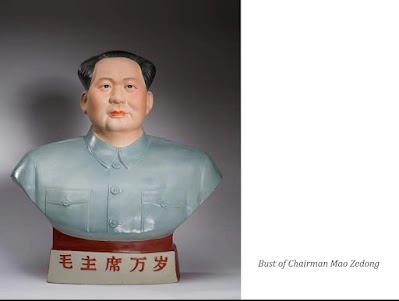
All of the art produced during this period was made to enforce the Little Red Book doctrines. Traditional art was banned and only realistic art that served the state was allowed. 

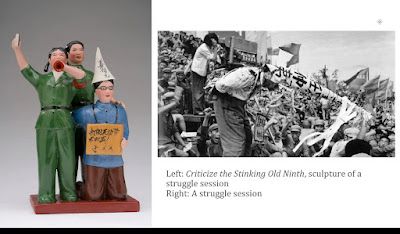
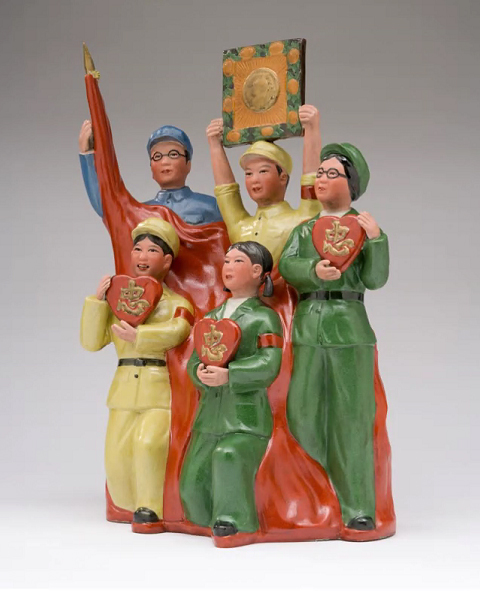
The shaming of intellectuals was a common practice. The real view on the right was bloody and violent. The sanitized ceramic version could be purchased to show your loyalty. 

The worker, the peasant and the soldier were elevated and idealized. 

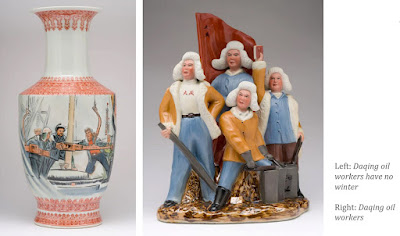
When traditional shapes were used it was only to illustrate workers, in this case, in the oil industry.

These are relatively small works and the figure were made in individual molds that could be used in a variety of groups. 

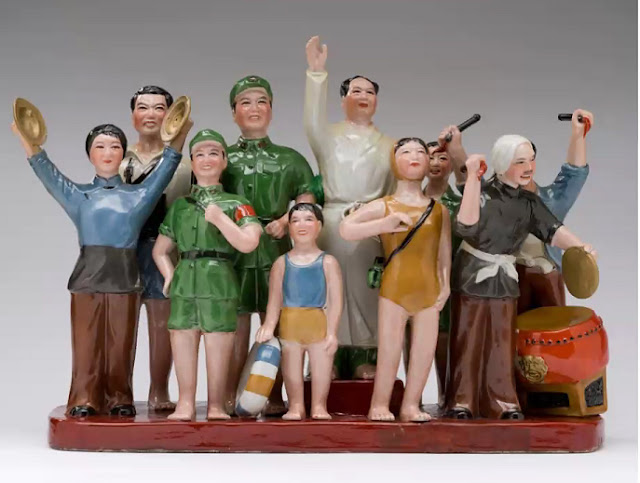
The Mao figure in this tableau is smaller so the artisan put him on a pedestal as he always had to be the highest one in any group.  


Making sure that Blacks and other Asians were included as part of the proletariat. 

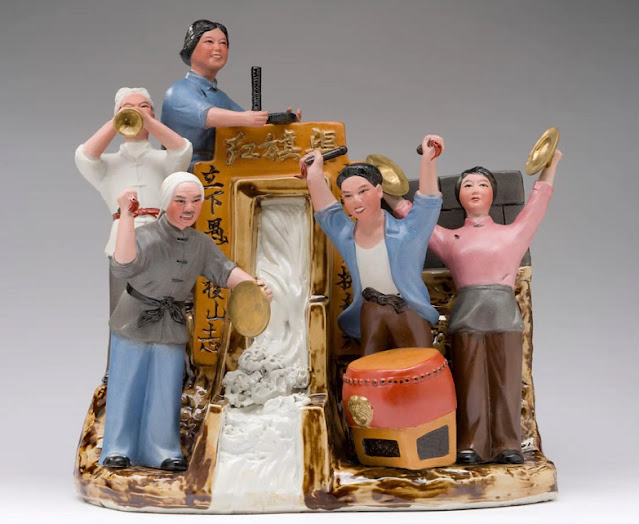
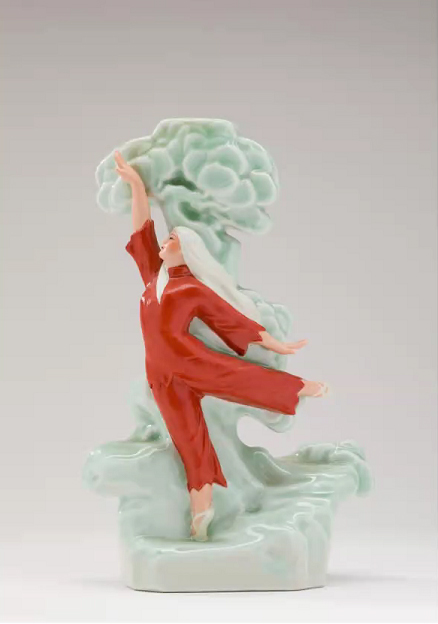
The Arts that served the cause were included like this figure from the ballet The White Haired Girl. Her landlord separated her from her lover and her hair turned white during her exile. 

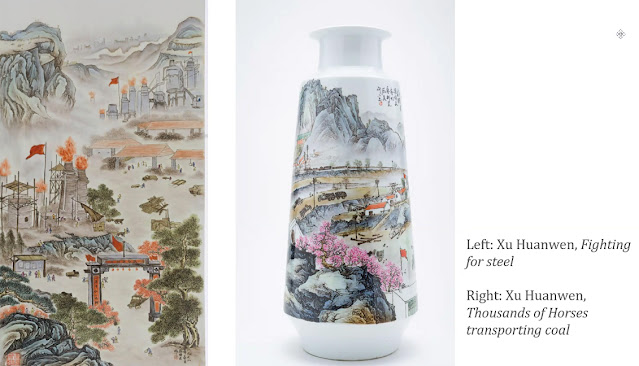
Traditional ink painting and landscapes are suspect but allowed when they glorified the work of the steel and coal workers. 

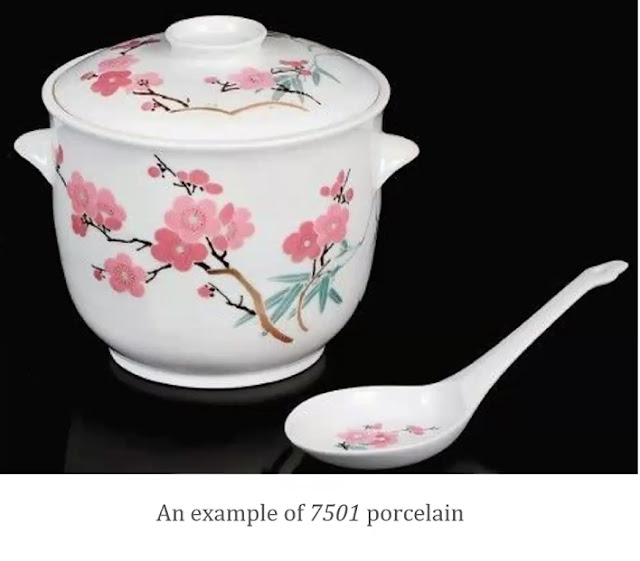
However, not everything at the top was as you might expect. These very fine, very white porcelain dishes with a totally artistic cherry blossom motif were commissioned for use at the Zedong residence. 


You can sign up for more information about the exhibition and check out other talks in this series at Chinese Cultural Center. I asked and was told that there will be further lectures on contemporary and modern Chinese ceramic art.   

For a site specializing in the historical archive of the Cold War go to The Wende Museum,


Many Fingers Touch Your Heart: Women’s Woven Voices at Front Porch Gallery

by Patricia Frischer 


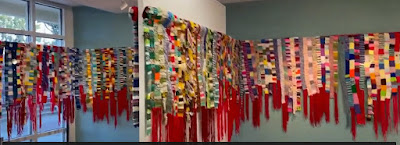
With the lockdown, we are still pretty much looking for online experiences and one of the best in December was a zoom celebration of the completion of the Women’s Woven Voices 1000+ story cloth weavings tapestry exhibition at FrontPorch Gallery with Julie Weaverling and founder Brecia Kralovic-Logan.

Brecia Kralovic-Logan and is that a Post for Peace and Justice I see next to her sign?


I had no idea what to expect but a dizzying video view of the show  and  the brilliant video of one of the weavers, Maggie, makes me more than ever want to look at least through the window of this Carlsbad gallery. Not only do they serve the community at large, but this show involves the residents in many of their facilities for assisted and independent living.

Maggie

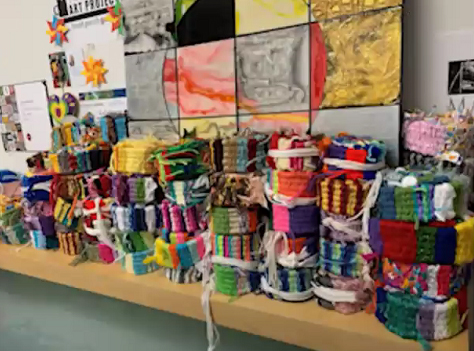
Some of the residents showing off their weavings. 


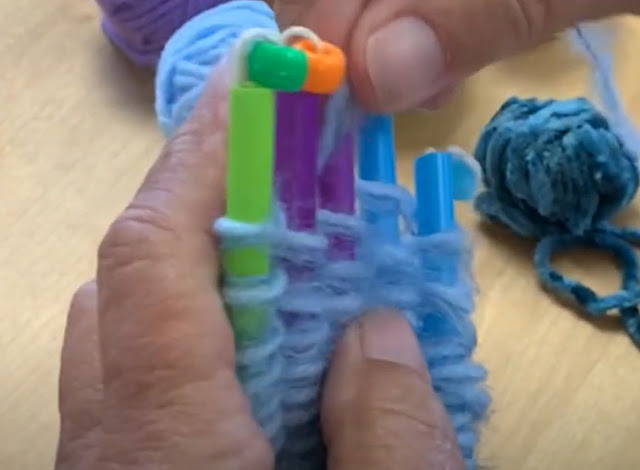
Women’s Woven Voices project is an international, collaborative art project that promotes women's empowerment through writing (guide), weaving (guide) and sharing (guide). When Front Porch became involved they hoped for 100 participants but are showing approx. 750 -  36 inch strips sewn together to make a chorus of voices.

Kits are available to get you started

An assortment of supplies

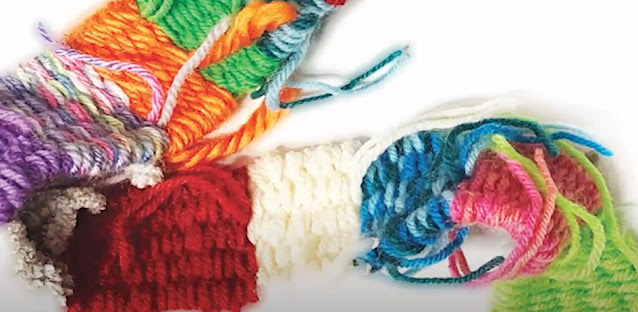
Close up of work in process

There are so many stories here. Some of very specific dedications, others are recollections and then there are just the intuitive expressions of colors.   

 The red fringe ties the whole group together graphically but it also symbolizes love  and creates a visual talking point about solutions to sexual abuse, a larger project.

Front Porch will display these artworks in all their facilities. Then it will go around the world hopefully with special stops in support of the Washington DC’s Commission on Women and Girls. 

Women's Woven Voices
showing until Jan. 8, 2022
Front Porch Gallery
2903 Carlsbad Blvd, Carlsbad, 92008

Saturday, November 27, 2021

Dark Side of Fashion Sustainability with Tara King-Haagen

By Patricia Frischer


Tara King-Haagen was the invited guest to the weekly Compassionate Art Conversations at the end of November. This is organized by Kira Carillo Corser and Tara is not only the Compassionate Arts marketing director but also a jewelry and sustainable artist for EarthTribe.  These are notes from the lecture.  


Why do you shop? For some it is retail therapy or recreation. For others, it is self expression. Maybe you just have the need to cover your body and stay warm.  But we could all become more aware of where our fashions originate. 

Sustainable to me could mean not using anything endangered and not exploitive. But there is a fine line that can blur between saving the animals and saving the environment. There is a lot of unfairness in the fashion industry. What makes one t-shirt worth $300 and another $3? We know branding is a big part of that dynamic.  

Sustainable fashion can be more expensive as research and new processes are developed . But when we support sustainable fashion and it becomes the norm, prices will come down.

So a few tips to make yourself more aware:

  •  Always recycle clothes. Don’t throw them away as they will just end in a land fill. 
  • Look for ways to upcycled clothes which makes them creative and  original.
  • Ignore fashion trends which encourage you to buy over and over. That is a marketing ploy.
  • Look for fashion that suits you, color, styles, shapes. 
  • If you buy something, get rid of something out of your closet.
  • When you buy,  look for original creative pieces that will last and about which you feel passionate.

·       Summing up: Buy less, choose well, make it last

Always recycle clothes. Don’t throw them away as they will just end in a land fill. 

Mother Nature knows best!

Find exceptional fashion and invest in fewer pieces. 

Research the sources of your clothes before you buy them.

Pineapples can be made into shoes.

Kelp can make faux furs.


Friday, November 12, 2021

Pretend I Am Dead and Bring Your Wallet

By Patricia Frischer

Luis Ituarte Open Studio 2021 - Nov. 12 -15, 2021, 10 am to 7 pm.
Reception Sat. Nov. 13 from 6 pm

3705 Rudnick Drive, Jamul, 91935 luis_ituarte@hotmail.com 619 455 5736 

Luis Ituarte; living his best life: Photo by Robin Brailsford


Luis Ituarte opens his studio this fall and shows the San Diego audience his range of art which is as wide as the combined brims of all the hats he wears i.e. 
working as a curator, program coordinator, art center director, art instructor, writer, and public speaker.  Ituarte has always produced art and has always had a job in the art community. Now, he and his wife, poetess Gerda Govine, have a large property in Jamul which can finally house their extensive output. 

Over a life time, he has worked in many mediums on many projects, but he is one of the few artist whose work in each series fortifies itself and never seems repetitive. I have chosen to show some multiples of these consecutive works so you get an idea, but I have also included some singular pictures which are  also a part of a larger series. 

The delight of an open studio tour is  to see a vast array of works as well as the inner workings of the actual work space. Ituarte is so generous to open his home and studio so the public can have this special view. On Saturday night from 6 pm there will be entertainment including a poetry reading by Govine.  And yes, bring your wallet and collect a number of these works now while you can still afford them. Ituarte is scheduled to have an exhibition at the CECUT in 2024. 

All following photos by Patricia Frischer (Yes, I take the blame for the bad quality!)


See if you can follow the dancing green line in these black light beauties. 

Photos taken under a black light. 


The curved line and delicate hand of this and the following works seems to have the influence of Jacque Cocteau, Erte, and Alexander Calder all at once. 


A more hearty version of the line, dances in these colorful wrought iron works. 

These works are all portraits and although abstract pay homage to the gesture of the body.


Free brush figure drawing on Chinese Gold good luck paper. 

Deeply colorful free gestures...remember there are dozens of these. 

A set of geometric plays on line, shape and color. 
Under the hot sun, cool off in the shade and take your time to go through stacks of art and choose your favorites.

Sumac pruned branches, are carved to reveal patterns as ancient as they are modern.


An overview of the property and garden.


These last  pictures are taken inside the artist studio and give you an idea of his inspirations.


Being born and raised in Tijuana Mexico, Ituarte completed his education in Mexico City and the City of Guanajuato in 1995.  He returned to Tijuana to start an exchange project  “Bajo El Mismo Sol” (Under the Same Sun) between LA and TJ.  In 2003, he founded Consejo Fronterizo de Arte y Cultura (COFAC)/Border Council of Arts and Culture, a non-profit organization dealing with border issues and the environment. Under the umbrella of COFAC, a house where a trafficking tunnel was discovered was transformed into La Casa del Túnel: Art Center that same year. In 2008 he founded Mariposa Artist Residency & Gallery, located across the street from La Casa del Túnel: Art Center. Ituarte turned both of these thriving projects over to a non-profit organization in 2013. He now lives and works in Jamul, CA.

Luis Ituarte Open Studio 2021 - Nov. 12 -15, 2021, 10 am to 7 pm.
Reception Sat. Nov. 13 from 6 pm
3705 Rudnick Drive, Jamul, 91935 luis_ituarte@hotmail.com 619 455 5736  

Monday, November 8, 2021

Dance Time at the Mingei Museum

By Lonnie Burstein Hewitt. Photos by Maurice Hewitt.


Saturday Night, 11/6/21: The nine performers in Everyday Dances, with John Malashock on the right.

In September, the Mingei International Museum had its grand re-opening, but I never got to see a performance in its new theater space until last weekend, when John Malashock, Founder and Artistic Director of Malashock Dance, brought his Everyday Dances there.

Malashock, who founded his company in 1988, has had a distinguished career as performer and choreographer, and invited five other local choreographers to join him in presenting a program of 10 short pieces at the Mingei, one from each of them, and five of his own.

Why the title? "It's a riff on the Mingei's name, which comes from the Japanese word meaning 'art of the people' or art from everyday objects," he said. "The idea is taking the everyday and making art out of it. Each piece runs between three and seven minutes-short is good these days-and each has its own style, so there's a broad range of artistic voices. The program is only an hour long, but it gives an idea of what's going on in the wider dance community here." 

The dances certainly brought the theater to life. A former loading deck, it's now a flexible space that can seat up to 120, but only offered seating for 60 at Everyday Dances to give the performers more room to move. It was a delight to feel close-but not too close-to the dancers, and to share a sense of spaciousness with the masked but obviously delighted audience.

The hour-long program opened and closed with pieces by Malashock-the first quite appealing, and the last quite dramatic-but every one of the ten dances had its own tone and style, and its own special appeal. "They're wonderful small-cast works, created in the spirit of the everyday, because we work every day," Malashock said in his introduction to the performance. 

The five guest choreographers-Blythe Barton, Ryan Orion Beck, Lauren Christie, Marcos Duran, and Odessa Uno--all offered distinctive pieces, and the pieces all fit together beautifully. Two of the choreographers-Lauren Christie and Marcos Duran-also danced in their own works. All the dancers were top-flight, and it was no surprise that all three performances were sold-out.

Everyday Dances also gave us a chance to admire the dancers' backdrop-the unusual curtain by Amsterdam-based designer Petra Blaisse, who was inspired by San Diego's jacaranda trees. Made of double-sided dyed felt cutouts, backed with a layer of sheer silk organza, it let in a just a bit of light from the streetlamps outside the glass wall of the theater, creating a softly mystical mood for the Saturday night performance.


Detail of the curtain by Petra Blaisse.

There will be a second weekend of Everyday Dances November 19-21 at Malashock Dance Studio Theater in Liberty Station. Tickets range from $10-35 for Friday and Saturday evenings, and the Sunday matinee is pay what you can. For details, go to  Malashock Dance Everyday Dances

The Mingei is open Saturday-Wednesday 10 am-5 pm, Thursday and Friday 10 am-8 pm. with new exhibitions coming soon. Admission ranges from free to $18, with the Commons Level free to all, and Artifact Restaurant opening for lunch and drinks starting November 17. 

Lonnie Burstein Hewitt is an award-winning author/lyricist/playwright who has written about arts and lifestyle for the La Jolla Light and other local media for over a dozen years. You can reach her at  hew2@sbcglobal.net.